- Doomsday Scenario
- Posts
- How did the US run out of missiles in Iran?
How did the US run out of missiles in Iran?
We spend $800-billion-a-year on defense—but the US stockpiles barely lasted through a six-week-war.

Garrett Graff
April 17, 2026 • Reading Time: 6 minutes
Welcome to Doomsday Scenario, my regular column on national security, geopolitics, history, and—unfortunately—the fight for democracy in the Trump era. I hope if you’re coming to this online, you’ll consider subscribing right here. It’s easy—and free:
I’ve long been intrigued by how the US spends around $900 billion — a number that accounts for perhaps a third of the entire world’s total defense spending and is equal to the annual defense budgets of China, India, Russia, Saudi Arabia, France, Germany, United Kingdom, Japan, South Korea, and Brazil combined — and yet often when we’re conducting military operations, we turn out to not have the “right” weapons or “enough” matériel like planes or ships. (That $900 billion, of course, is before Donald Trump’s new proposed increase to add $700 more billion to the defense budget, a number alone larger than any other nation spends on its military.)
The war in Iran has been one case study after another in how “limited” the “world’s greatest military” actually turns out to be when it comes to war-fighting. USA Today has another entry today in the type of scandalous and worrisome story that would for any Democratic president result instant calls for impeachment: US navy ships are, in a war zone, running out of food to serve their sailors. The food problem is just one sign of a military being stretched further than it should: Many units have been deployed far longer than anticipated—and longer than they can sustain. The USS Gerald Ford, the world’s most advanced aircraft carrier, has been sidelined by a laundry fire.
As it turns out, much of the US fleet in the air and sea is older and smaller than should be.
When the US recently lost an E-3 Sentry AWACS radar plane in an Iranian missile strike on a base in Saudi Arabia, the targeted plane represented perhaps a quarter or a fifth of the US Air Force’s deployable fleet for a critical eyes-in-the-sky role defending against Iranian missiles and drones.
The US E-3 Sentry fleet of so-called Airborne Warning and Control System (AWACS) planes dates to the 1970s and today comprises just 16 or 17 airworthy aircraft — about half of which are operable at any given time and six of which are deployed to the Middle East to support Operation Epic Fury. (“We basically have [the E-3 AWACS] airplanes in hospice care,” the general in charge of Air Combat Command told reporters last year.) Meanwhile, the anticipated replacement, the E-7 Wedgetail, was recently canceled by the Trump administration.
Similarly, when Iran threatened to begin mining the Strait of Hormuz, it turned out that the US Navy had shipped back to the United States in January the four Avenger-class minesweepers originally deployed to the Persian Gulf in the 1990s. The four remaining US minesweepers are based in Japan, as the navy is transitioning its minesweeping responsibilities to Littoral Combat Ships (LCS) that are not purpose-built for the mission.
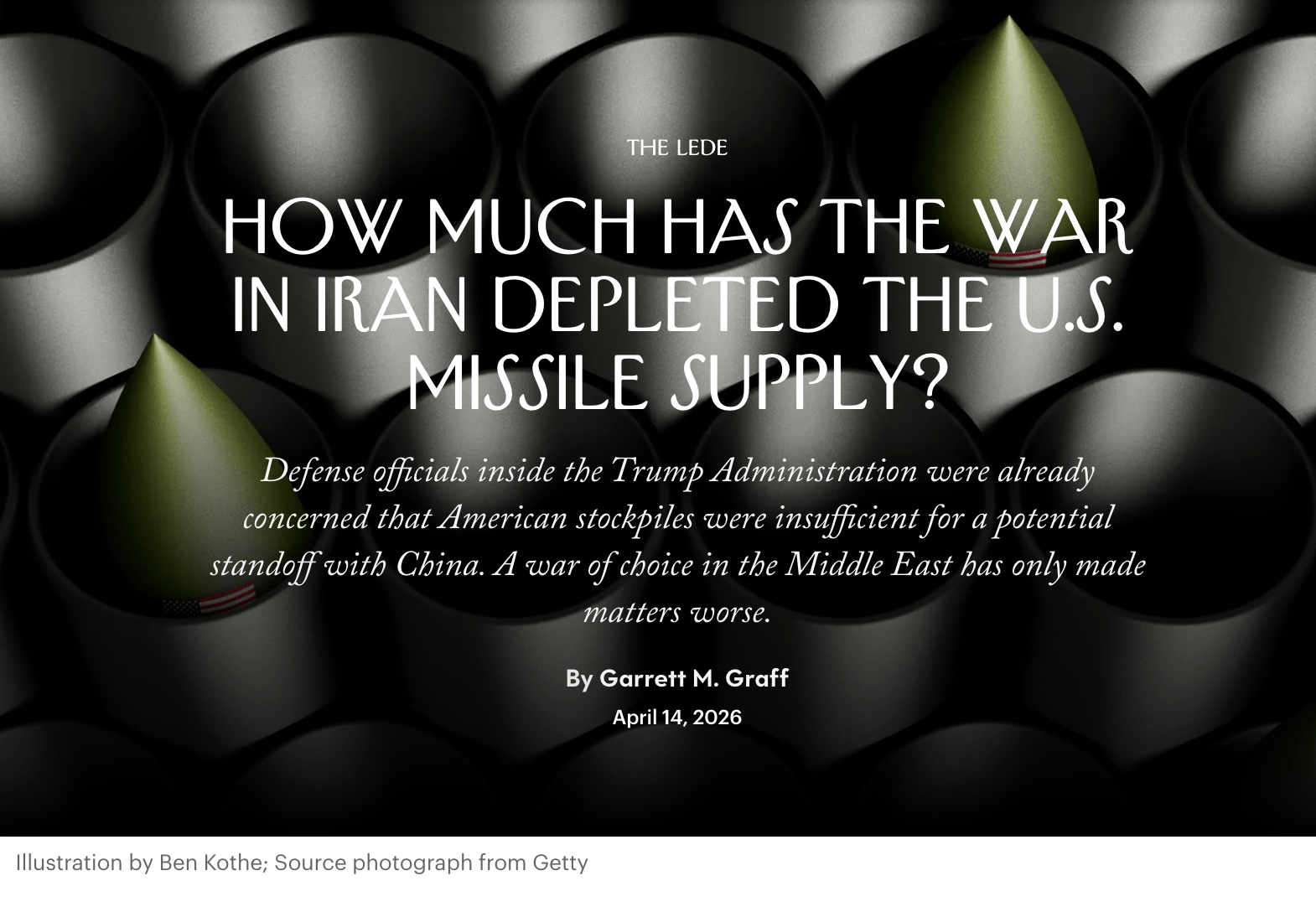
This week, my latest article in the New Yorker explores how the US just used up a ton — in some cases, evidently even “most” — of the missiles and interceptors that it would most need and rely upon in deterring China from moving against Taiwan:
The crisis of American defense production has been slowly worsening since the start of the Russian invasion in Ukraine. “Official Washington added a new word to its vocabulary in the months after February, 2022, and that new word was ‘munitions,’ ” Karako told me. Jon Finer, who served as Biden’s principal deputy national-security adviser, said that the limited ability of the United States to meet the endless need for weapons in the war in Ukraine was the “the most jarring thing that I learned during the entire time I was in government.”
As Finer recalled to me, “Russia invades Ukraine; we collect every loose munition that exists anywhere in our own stockpiles and in all of our friends’ stockpiles—and even some countries that weren’t our friends who we could buy this stuff from—and we pumped them into Ukraine. The war is so munitions-heavy that they blow through those in a matter of months. So we go to our industry and are like, ‘All right—good news for you, big orders coming, how quickly can you ramp up?’ And the answer was like ‘5 to 7 years.’ Totally unacceptable.”
The answer, it turns out, is that basically the US defense industry gave up making munitions amid the Global War on Terror over the last two decades. “Over time, the industrial base has prioritized efficiency over resiliency,” William “Bill” LaPlante, the undersecretary of defense for acquisition and sustainment, said in 2023. “We’ve allowed production lines to go cold, watched as parts became obsolete, and seen sub-tier suppliers consolidate or go out of business entirely,” adding, “No one anticipated the prolonged high-volume conflict we’re seeing in Ukraine.”
As I wrote this week:
Heavy-duty munitions had long been an afterthought in the “global war on terror,” which prioritized close fighting, special forces, and weapons platforms such as the Predator and Reaper drones. “We adjust our industrial base to the kinds of wars that we are fighting,” Finer told me. “I think we got out of the mind-set where we were ever going to fight a very munitions-heavy war again. That was a bit of a failure of imagination.” At the same time, the nation’s weapons manufacturers—part of what is known inside the Beltway as the defense-industrial base, or DIB—have grown cautious after years of fast-shifting congressional priorities. “If you’re a defense prime, you have basically had to use a Ouija board and a divining rod to try to guess what number of munitions that the government will want to buy two years from now,” Karako said. “These are publicly traded companies—they have to maximize the return for their stockholders—and they can’t, unfortunately, as good Americans, build stuff on spec and hope that the government will show up and buy it.”
Pentagon procurement of course has become notoriously slow, calcified, and prone to false starts; the KC-135 aerial refueling tankers that serve as the backbone of major US airborne operations like the war in Iran first entered service in 1957 and the Pentagon has been trying to replace them since the 1990s. Its replacement, the KC-46 Pegasus, was only approved for use in 2022 and Epic Fury is its first major military operation — and the Air Force still anticipates flying KC-135s for decades to come.
Here’s a fact that will blow your mind: The KC-135 started flying during Dwight Eisenhower’s administration — and sometime late next decade, e.g., well into the 2030s, the last American to fly a KC-135 will be born, which means the last parents of a KC-135 pilot are probably in middle school right now.
There are a lot of layers in the Pentagon that can cancel or delay a weapons systems or procurement order. When I was writing about the then-proposed creation of the Space Force in 2018, I learned that one of the little-understood needs for breaking away from the Air Force and creating a stand-alone Space Force was that it would something like halve the number of offices that had to approve a new satellite system.
The other major driver is just how expensive US weapons systems have gotten. The F-35 fighter program alone is now estimated to cost $2 trillion over the course of its lifecycle — that’s basically the entire GDP of New York or Texas for a single year going to fund a single fighter aircraft. That means we just can’t build as many as we might want to — or might have used to build.
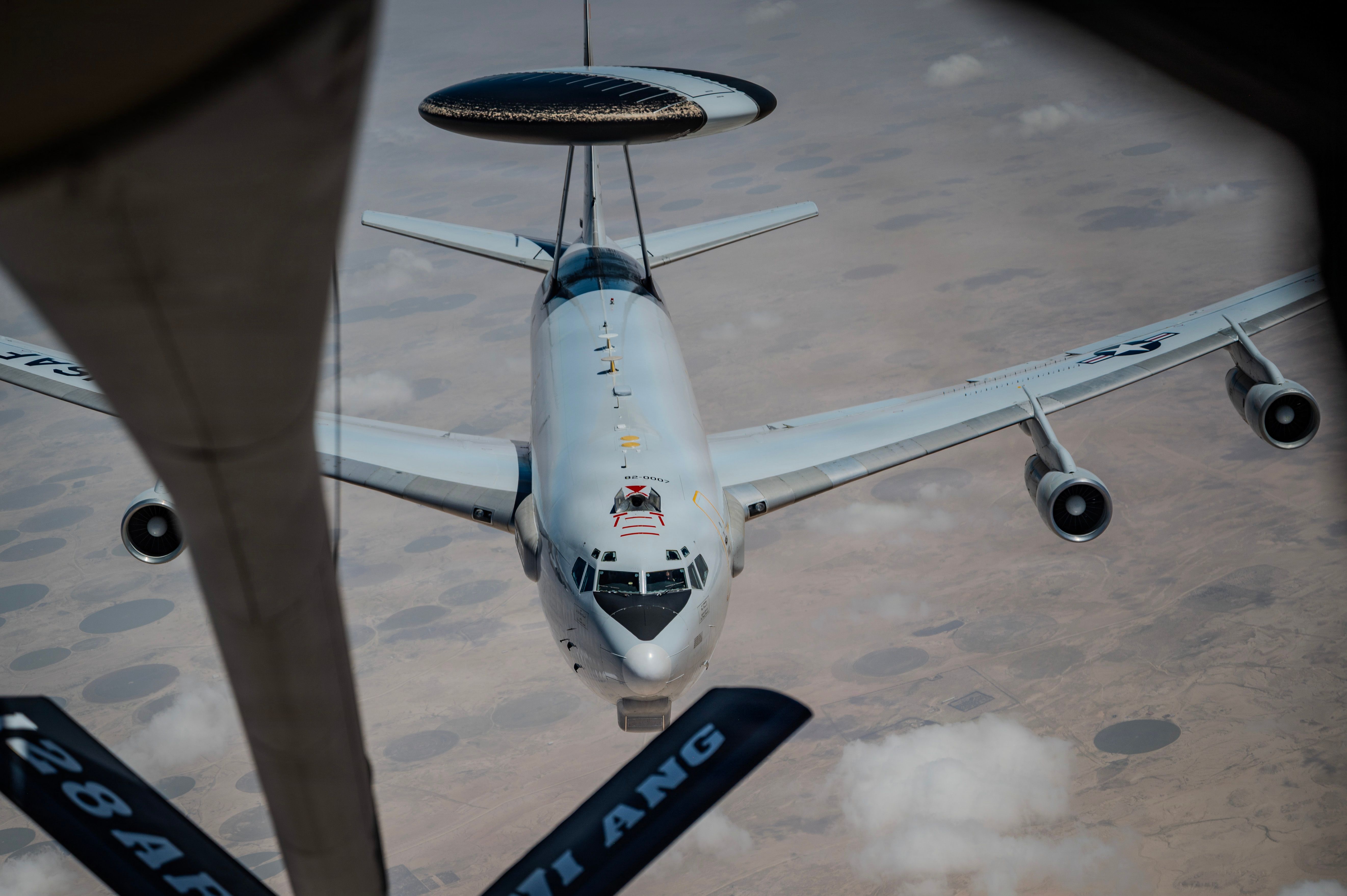
One of the Air Force’s few remaining E-3 Sentrys, as seen from a refueling tanker, amid the war in Iran. (US Air Force photo)
For the article, I interviewed Deborah Lee James, who served secretary of the air force from 2013-2017, and who explained how despite the gargantuan size of the US defense budget, the money goes less far than some might imagine — about half of the budget is allocated to personnel and training costs — and procurement has to stretch to cover the needs of all the different branches. “There are hard judgments that have to be made,” she says. “The weapon systems that we are churning out today are magnificent, but they’re highly expensive. Quantities are difficult to come by…. Munitions, if you’re not in the middle of a hot war, don’t come to your attention as much as the need to buy those extra F-35s, or if you’re the Navy, to try to get under construction a couple of new destroyers or submarines.”
As I explain and trace in the piece, the implications for all of this on the stockpiles we’ve expended in attacking Iran in an entirely unnecessary war-of-choice might be profound. Online military forums regularly joke now about how CENTCOM, the US military’s Middle East command, is devouring the resources desperately wanted by INDOPACOM, its Indo-Pacific Command.
Most of the missiles and interceptors we’ve used to attack or defend against Tehran will not be able to replaced before the “window of opportunity” opens militarily and geopolitically for China to attempt to seize Taiwan later this decade. China is surely closely monitoring and watching that.
But on the other hand, as many of the sources I spoke with for the piece pointed out, China’s path ahead would not be easy. “The problem that China has to solve in a Taiwan contingency is a really, really hard problem operationally,” a senior Pentagon policy official told me. “Obviously, we don’t sleep on what Beijing is capable of — they’re building their military with a remarkable degree of focus and consistency — but that doesn't change the fact that the military problems they would need to solve is extremely difficult.”
Moreover, as Senator Mark Warner, the vice chair of the Senate Intelligence Committee, told me when I was interviewing him for the article, the biggest deterrent for China in the end might simply be how poorly the US war against Iran has been going. China is surely carefully watching how even a much-battered Iran stopped the US in its tracks strategically in the Strait of Hormuz. As Warner said, the biggest lesson of the war with Iran might be one of the simplest: “It’s a lot easier to be a defender than offense.”
GMG
PS: If you’ve found this useful, I hope you’ll consider subscribing and sharing this newsletter with a few friends: