- Doomsday Scenario
- Posts
- Remembering Robert Mueller
Remembering Robert Mueller
The reporting subject I knew best

Garrett Graff
March 22, 2026 • Reading Time: 17 minutes
Welcome to Doomsday Scenario, my regular column on national security, geopolitics, history, and—unfortunately—the fight for democracy in the Trump era. I hope if you’re coming to this online, you’ll consider subscribing right here. It’s easy—and free:
Robert Mueller, the quintessential G-Man, a patriot and Purple Heart recipient who spent a half-century serving the country and pursuing the highest traditions of the Justice Department across six presidential administrations, repeatedly answering the nation’s call — from Vietnam to the halls of the J. Edgar Hoover building and the halls of Main Justice — until in his final chapter of public service he was betrayed by a former colleague and the Republican Party he’d spent a lifetime supporting, died Friday. He was 81.
I’ve spent much of the last twenty years writing about Robert Mueller, both as FBI director and then as special counsel in the Russia investigation. Ironically, I came to know him — a famously reticent and spotlight-averse Washington figure — intimately in a way few journalists ever get to know a subject. (My Mueller coverage over the years is probably how many of you first came to know and read me!) I spent dozens of hours interviewing him, shadowed him through his workdays and traveled repeatedly with him across the country on the FBI director’s jet; interviewed scores of people about his history and career, including his wife, best friend, and closest aides, and wrote the closest thing that exists to a biography of him — the first of thus far four books that focus heavily on the bureau — as well as the definitive story about his time in Vietnam, which influenced the course of his life in myriad ways.
I’ve described him over the years as “America’s straightest arrow,” and while there have been several good full-length obituaries this weekend, I think looking across his career there are two stories that best illustrate who Robert Mueller was at his core.
First, there’s his time at the “Triple Nickel.”
By the early 1990s and the end of the George H.W. Bush administration, Mueller had risen to the top ranks of the Justice Department — assistant attorney general for the criminal division, overseeing all of the nation’s federal criminal prosecutions. It’s normally a terminal career role — the type of role that people then cash in and refer to for the rest of their careers. Mueller, indeed, did that for a brief moment — but he hated the private sector. (Instead of offering to defend one wrongdoer, Mueller said the defendant, then in jail, was “right where he belongs.”) After a while, Mueller called Eric Holder, then the US attorney for Washington, D.C., and asked to come back as a homicide prosecutor — it was the rough equivalent of a three-star general retiring and then asking to re-enlist as a first lieutenant.
The story of Mueller arriving in the overworked and chaotic D.C. US Attorney’s office at 555 Fourth Street, Northwest — the “triple nickel,” as it was known — is at one level a testament to Mueller’s own personal moral compass and drive, but many people miss the second important backdrop: D.C. in the early 1990s was overrun by homicides. As Eric Holder told me almost twenty years ago, “It was an office that was almost under siege. DC was the homicide capital of the United States. We had a crack problem that had spiraled out of control. Huge numbers of homicides that were mostly in one way or another drug-related, huge numbers of violent crimes, problems with the police, even all the way up to the mayor.”
By stepping back into not just prosecuting, but specifically prosecuting homicides in Washington, D.C., Mueller was signing up for the biggest challenge — and highest service — he could find.
He loved being a prosecutor again — colleagues recalled to me how he always answered the phone brusquely with “Mueller—homicide” — and helped lead the prosecution of notorious incidents like the Georgetown Starbucks murders and an incident in which a drunk Georgian diplomat killed a teenage girl in a car accident near Dupont Circle.
Over the course of the 1990s, he rose through the ranks of DOJ all over again, taking over the troubled U.S. attorney’s office in San Francisco and then, becoming acting deputy attorney general in the first months of the George W. Bush administration. He had a uniquely strong code of personal honor and integrity, one deeply inspired by his father. At the Justice Department, he’d earned the nickname — never spoken to his face of course — “Bobby Three Sticks,” a play on the Roman numeral at the end of his name, Robert Swan Mueller III, and a reference to the Boy Scout salute.
In the summer of 2001, he was nominated and confirmed 98-0 as the sixth director of the FBI. In the years ahead, he would become the first to complete the ten-year term imposed after Hoover’s half-century reign and would be extended by Congress and President Obama another two years, this time by a vote of 100-0. In the end, he was appointed to senior roles in six consecutive presidential administrations of both parties.
Bob Mueller might have been the last person in the US government that both parties agreed upon and respected beyond reproach.
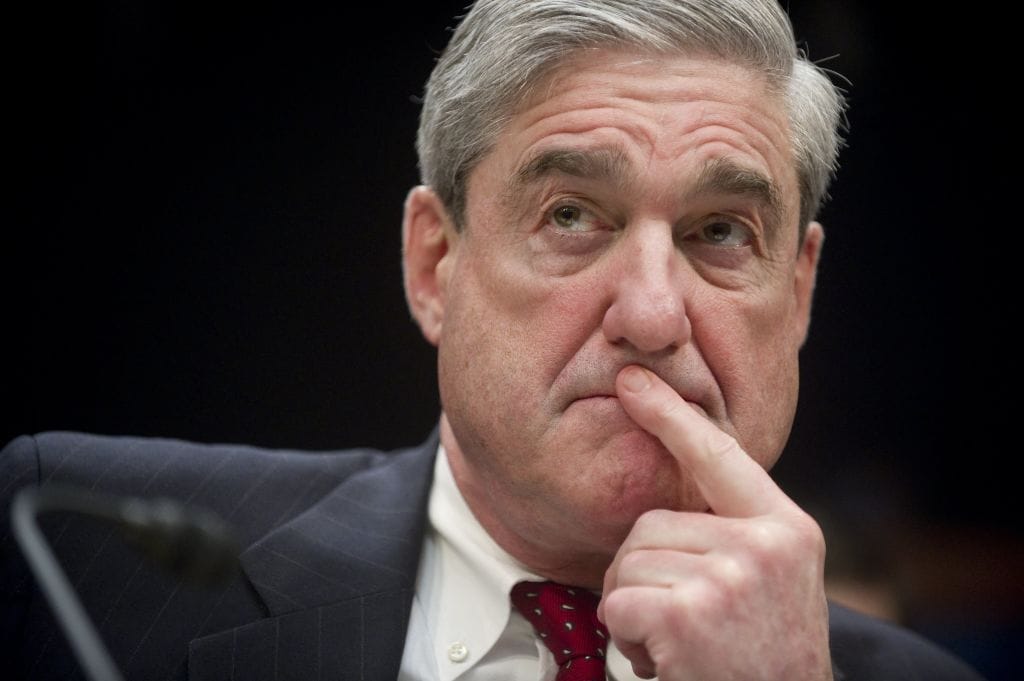
Robert Mueller, as FBI director, here in 2011, religiously wore white shirts. (Photo by Saul LOEB / AFP via Getty Images)
Second, there were the white shirts.
On his first day as FBI Director James Comey wore a blue shirt to the office — it was a subtle but instantly recognizable statement that there was a new guy in charge who wasn’t Bob Mueller. Mueller as director had worn white shirts, plain ties, and dark traditional suits with almost a religious devotion — and he expected everyone else around him to do the same as director. It was the same unofficial official uniform that J. Edgar Hoover had enforced as director; and I joked — not joked — in my original profile about how “colored shirts are worn at one’s own peril. The head of the bureau’s public-affairs division, John Miller—a former ABC investigative reporter who interviewed Osama bin Laden in the 1990s—tries to sneak in a colored shirt on occasion, but Mueller will look down the table at the 9 am staff meeting and ask, ‘John, what exactly are you wearing?’”
People had long assumed that the white shirts were just him being fastidious and strait-laced. But years after he was director, I off-hand asked him at one point: Why the cult of the white shirt? Mueller was not much interested in introspection, and so I was all the more surprised that his answer was actually the most philosophical thing I ever heard him answer. He immediately launched into how as FBI director after 9/11 he knew he was leading the bureau through a disorienting and wrenching period of change — transforming a traditional domestic law enforcement agency into an international intelligence agency focused on counterterrorism — and he felt it critical that as he led the FBI into a new future that his style of dress represent a recognizable totem of the bureau’s future. The bureau in the 2000s, after all, was still not that far-removed from the era of J. Edgar Hoover — its corps of executive leaders, who all had 20 to 25 years of service, had all been trained by men who had been hired and trained by Hoover. The white shirt represented their tradition and nodded to the bureau of old. Mueller’s answer was a masterclass in leadership and change management in a few short sentences.
* * *
Robert Mueller surprised me from the first moment I met him; we were standing in a hallway at Quantico, at the FBI Academy, where I’d gone for my first day of reporting on a profile of him for Washingtonian Magazine in the spring of 2008. I had just finished a profile of Tom Friedman, who was at the height of his influence at the time with The World Is Flat, and my editors and I had settled on Mueller as my next subject somewhat by chance — a big magazine profile takes a couple months to report and write, and given the spring uncertainty of the presidential race, it was hard to know what other national figures in Washington would still be relevant by the fall. But the FBI director’s ten-year term meant he’d survive into the next administration and, besides, very little had been written about Mueller.
For that first day with him, I — of course — wore a navy suit and white shirt and when he came up to me in the hallway, I immediately pointed out my sartorial choice. He, though, launched into how he’d read my Friedman piece and then began to lay out what The World Is Flat and globalization meant to the FBI. It was an eye-opening conversation — and laid the groundwork, eventually, for my book about how he had transformed the FBI after 9/11 and the four-decade story of how the bureau had gone global to combat terrorism and an increasing number of threats, like cybersecurity, that reached far beyond our shores. Mueller, as it turned out, had been at the center of much of that story — he’d helped lead the prosecution of the bombing of Pan Am 103 and his dedication to the justice for its victims was one of his most closely-held personal missions.
Mueller had taken over as FBI director on September 4, 2001, and spent that first week trying to get up to speed as quickly as he could on the huge sprawling responsibilities of the bureau. Each morning at 8 a.m., executives and agents had organized a series of briefings on the FBI’s biggest ongoing cases, and so it was that at 8 a.m. on Tuesday morning, September 11, 2001, Mueller was sitting down for his first briefing on al-Qaeda and the bombing of the USS Cole, the previous year in Aden harbor in Yemen. The case, codenamed ADENBOM, was proving to be a difficult and challenging investigation, with agents having to balance local security threats with a fraught political environment.
Midway through the ADENBOM briefing, an agent interrupted to say that a plane had hit the World Trade Center. Even sitting in the briefing on al-Qaeda, “terrorism” wasn’t actually Mueller’s first thought after the first crash — he had the same reaction people up, down, and across the east coast had that morning in the minutes before the second attack. He looked out the windows of the director’s seventh-floor suite in the Hoover Building overlooking Pennsylvania Avenue, and seeing the beautiful, crisp blue sky of that fall day, said out loud: “How could a plane not see the tower? It’s so clear today.” Then the second crash — and it was clear that the nation was under attack. Mueller’s tenure — and the FBI — would never be the same. He had a lot to learn still — one evening shortly after the attacks, he called the FBI Command Center to check for updates and asked the operator who was in charge. She paused and said quietly, “You are, sir.”
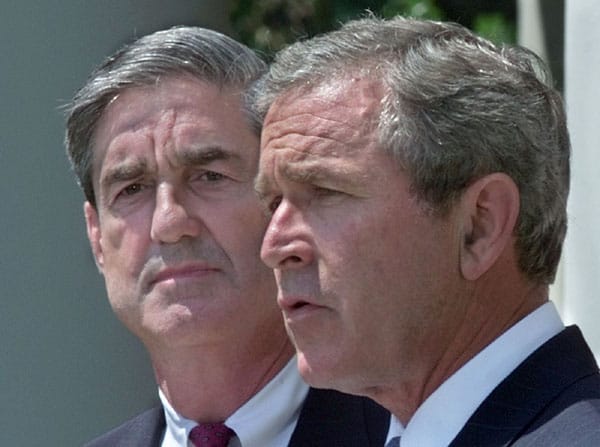
Mueller at the Rose Garden announcement of his nomination as FBI director in the summer of 2001. At the announcement, Mueller spoke for just 48 seconds. (White House Photo by Eric Draper)
Over the years ahead, Mueller became the most influential FBI director since Hoover — but also one of the most critical and longest-serving officials in the post-9/11 US government. His tenure would stretch across two presidents, three secretaries of homeland security, four attorneys general, five national security advisors, six CIA directors, and countless other senior leaders, including two of the most influential vice presidents the nation has ever seen, Dick Cheney and Joe Biden.
He had a reputation for being gruff and brusque, but he’d also faced thousands of morning terrorism threat briefings after 9/11 and worked hard to keep the FBI sure-footed after the attacks — he refused to allow the FBI to participate in the torture programs of the CIA and, famously, with Comey, had resisted renewing an NSA domestic surveillance program that the then-deputy attorney general had deemed unconstitutional. His best friend — Mueller’s former Princeton classmate and one-time F.B.I. chief of staff — W. Lee Rawls recalled that Mueller expected his orders to be executed in the Hoover building just as they had been on the battlefield. In meetings with subordinates, he had a habit of quoting Gene Hackman’s gruff Navy submarine captain in the 1995 Cold War thriller Crimson Tide: “We’re here to preserve democracy, not to practice it.”
By the time I began profiling him in 2008 though — and, eventually, writing his biography, THE THREAT MATRIX, which came out in 2011 — he had grown more comfortable, if not exactly relaxed, and for reasons I will never quite know or understand, allowed me a stunning level of access to the bureau.
When I first sat down with him to tell him I was going to write a book about him, he tried to talk me out of it, and I said, “Look, you’re the most boring part of the FBI — if you don’t want the book to be about you, give me access to more interesting parts of the FBI than you.” He agreed — and was as good as his word: Over two years, I spoke with upwards 150 FBI agents, analysts, staff, and executives, often for hours at a time, and he opened up every office and team I wanted to interview. At one point, I spent a day down at Quantico with the elite Hostage Rescue Team, and the team’s leader, Jim Yacone — himself a stunning American hero, one of the helicopter pilots from Mogadishu in Black Hawk Down, who had his first helicopter shot down and then returned to the fight with a second — began the morning saying, “I have no idea why you’re here, but I’ve been ordered to welcome you.”
Mueller and I kept in regular contact after he left the bureau, but I figured that I’d written my last words about Mueller. Much to my later regret, I ditched three giant bankers’ boxes of papers about his involvement of Pan Am 103 and the prosecution of Manuel Noriega when I moved home to Vermont in 2015 — boxes of papers I’d only gotten through the Freedom of Information Act after successfully suing the FBI and Justice Department. (It had been a valuable lesson for me: If you still have to sue the FBI even when the director is cooperating, how hard will the bureau fight to keep secret the things it really doesn’t want you to know?)
Five years after his term as FBI director, though, Mueller was named special counsel to investigate Donald Trump, Russia, and the 2016 election. Despite his lifetime of public service, it was the first time most Americans ever heard his name — and turned him from an anonymous, publicity-shy public servant into something of a cult figure.
As people hungered to understand what made Mueller tick, I dug back into his time in Vietnam for what came to be a WIRED cover story in 2018. I spent months tracking down something like 200 people who had served in Mueller’s unit a half-century earlier, scrambling to find ultimately a dozen or so who actually remembered him and had overlapped with him in Vietnam. Many hadn’t realized that the man they were reading about on the news was the same one who had served with them back then. For almost all of them — Mueller included — Vietnam was the formative experience of their young lives, impressing on them at an early age key lessons in leadership, honor, and duty. I was surprised how many veterans of his 2nd Battalion still had email addresses referencing their Vietnam service: gunnysgt, 2-4marine, semperfi, PltCorpsman, Grunt. I found one Marine whose email address even referenced Mutters Ridge, the battle in December 1968 where Mueller first faced large-scale combat.
As I wrote at the time, “Today, the showdown between Special Counsel Robert Mueller and President Donald Trump stands as an almost Shakespearean tale: a story of two men, born just two years apart, raised in similar wealthy backgrounds in northeastern cities, both deeply influenced by their fathers, both prep school athletes, both Ivy League educated, who now find themselves on opposite sides of a historic investigation of political corruption and Russia’s role in the 2016 election. As adults, the two lived in pursuit of almost diametrically opposed goals—Mueller a life of public service, Trump a life of private profit—driven by values that could not be more different.”
Those “divergent paths” began with Vietnam — where, “despite having been educated at an elite private military academy, Donald Trump did everything he could to avoid serving in the military—drawing four educational deferments and then a final 1-Y medical deferment for bone spurs in his feet. (Until his medical deferment, Trump had trumpeted his athleticism. He was a star athlete in prep school, much like Mueller, playing football, tennis, squash, and golf.)”
“In the years since, Trump had often joked about the Vietnam conflict and military sacrifice. In 1998, in an interview with Howard Stern, he said he was ‘getting the Congressional Medal of Honor’ for his ability to stay alive after ‘screwing a lot of women.’ Stern joked that avoiding sexually transmitted diseases in New York was Trump’s ‘Vietnam.’ Trump agreed, saying, ‘It is my personal Vietnam. I feel like a great and very brave soldier.’ More recently, on the campaign trail, he derided John McCain for his years as a prisoner of war in North Vietnam’s infamous Hanoi Hilton prison, and when a wounded veteran handed candidate Trump his Purple Heart medal as a token, Trump said, ‘I always wanted to get the Purple Heart. This was much easier.’”
Mueller, not for the first or last time, had chosen the harder path — he not only volunteered for the Marines right out of Princeton, inspired by an older classmate, David Hackett, who would lose his life in Vietnam, but Mueller actually underwent surgery and spent a year of rehabilitation to repair an injured knee in order to serve. “One would have thought that the life of a Marine, and David’s death in Vietnam, would argue strongly against following in his footsteps,” Mueller said in a 2013 speech. “But many of us saw in him the person we wanted to be, even before his death.”
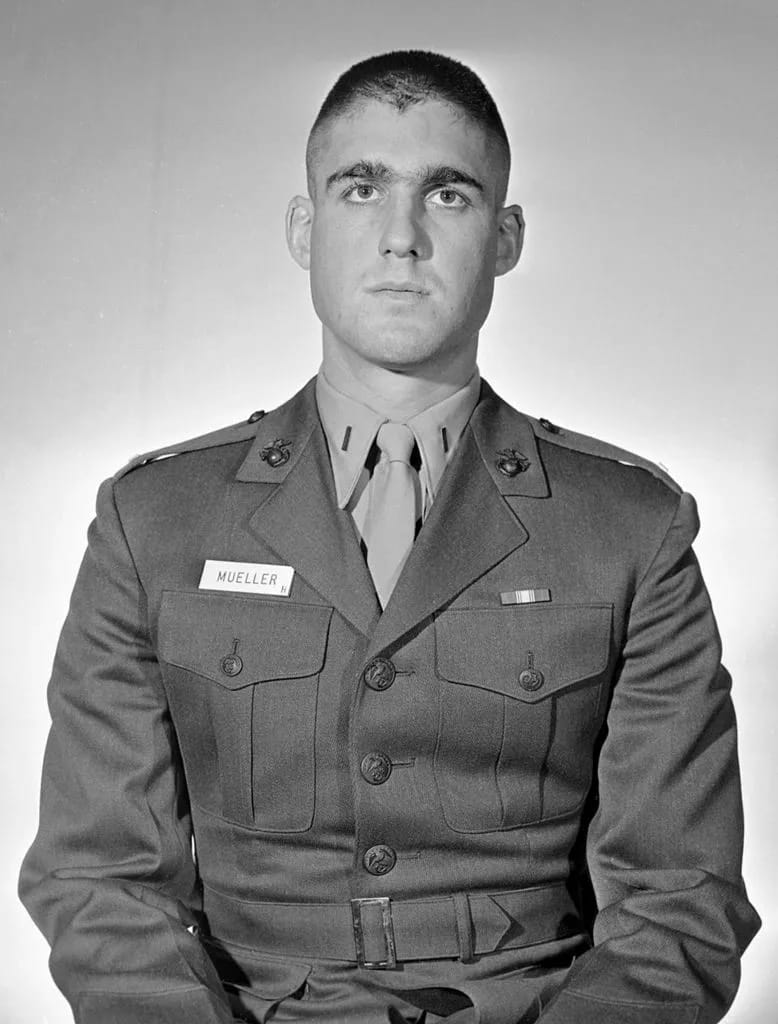
He soared through Officer Candidate School — on graduation day, Marine legend General Lewis “Chesty” Puller and actor Jimmy Stewart watched as the recruits became Marines, as both men had sons in Mueller’s class. The top graduate? Robert Mueller. The week of Mueller’s graduation marked the deadliest week yet for American troops in Vietnam; 416 dead, 2,757 wounded.
Mueller had hoped to go to language school, but instead was one of the few Marines sent to Army Ranger School — training he would credit with saving his life in combat — and then Army airborne parachute school. Mueller would always remain proud of passing the course. As he said at West Point just weeks before he was appointed special counsel, “On my resumé, I have always included the fact that I am a Ranger. In the Marine Corps, we eschew badges and flashes, and therefore I have never been allowed to wear the Ranger tab [the yellow-and-black badge awarded to all Rangers]. But I keep that on my resumé even though most people who see it may wonder why it is there. It may not be meaningful to them, but it is meaningful to me. I confess I am here today because of that Ranger School training.”
He arrived in Vietnam months after the Tet Offensive, in the fall of 1968. Speaking with me decades later — looking back at his 50-year career at the pinnacle of Washington power — it was that year of combat experience with the Marines that still towered in his mind. “I’m most proud the Marines Corps deemed me worthy of leading other Marines,” he told me.
Most of all, the military instilled in Mueller a sense of discipline. One day after he’d been director, we were talking he told me how he still made his bed every day as the Marines had taught him. I well-knew and kidded him about his strait-laced reputation, so I laughed and said, “That’s the least surprising thing I’ve ever learned about you.” But Mueller insisted it mattered — it was an important, small daily gesture, one of his life lessons on follow-through and execution. “Once you think about it — do it,” he said. “I’ve always made my bed and I’ve always shaved, even in Vietnam in the jungle. It’s an element of discipline — you’ve put money in the bank in terms of discipline.”
Mueller was in charge of 2nd Platoon, Hotel Company, 2nd Battalion of the 4th Marine Regiment, a storied infantry unit of the Corps whose motto was “Second to None,” who had earned the nickname “Magnificent Bastards.” The 2/4 was assigned to Quảng Trị Province, right along the Demilitarized Zone, and saw some of the heaviest fighting of the war, usually up against the regular North Vietnamese Army. A lot of his Marines doubted him at first — another “Gold Bricker” fresh out of OCS. “Word was out real fast—Ivy League guy from an affluent family. That set off alarms. The affluent guys didn’t go to Vietnam then—and they certainly didn’t end up in a rifle platoon,” one of his Marines, VJ Maranto, told me. “There was so much talk about ‘Why’s a guy like that out here with us?’ We weren’t Ivy Leaguers.”
Indeed, none of his fellow H Company Marines arrived in Vietnam fresh out of a master’s degree program, as Mueller had. Most were from rural America, and few had any education past high school. Mueller’s unit was at the center of the action — it was so constantly on patrol that battalion records described it as “nomadic.” In December 1968 alone, the unit would traverse more than 50,000 square meters of the Demilitarized Zone.
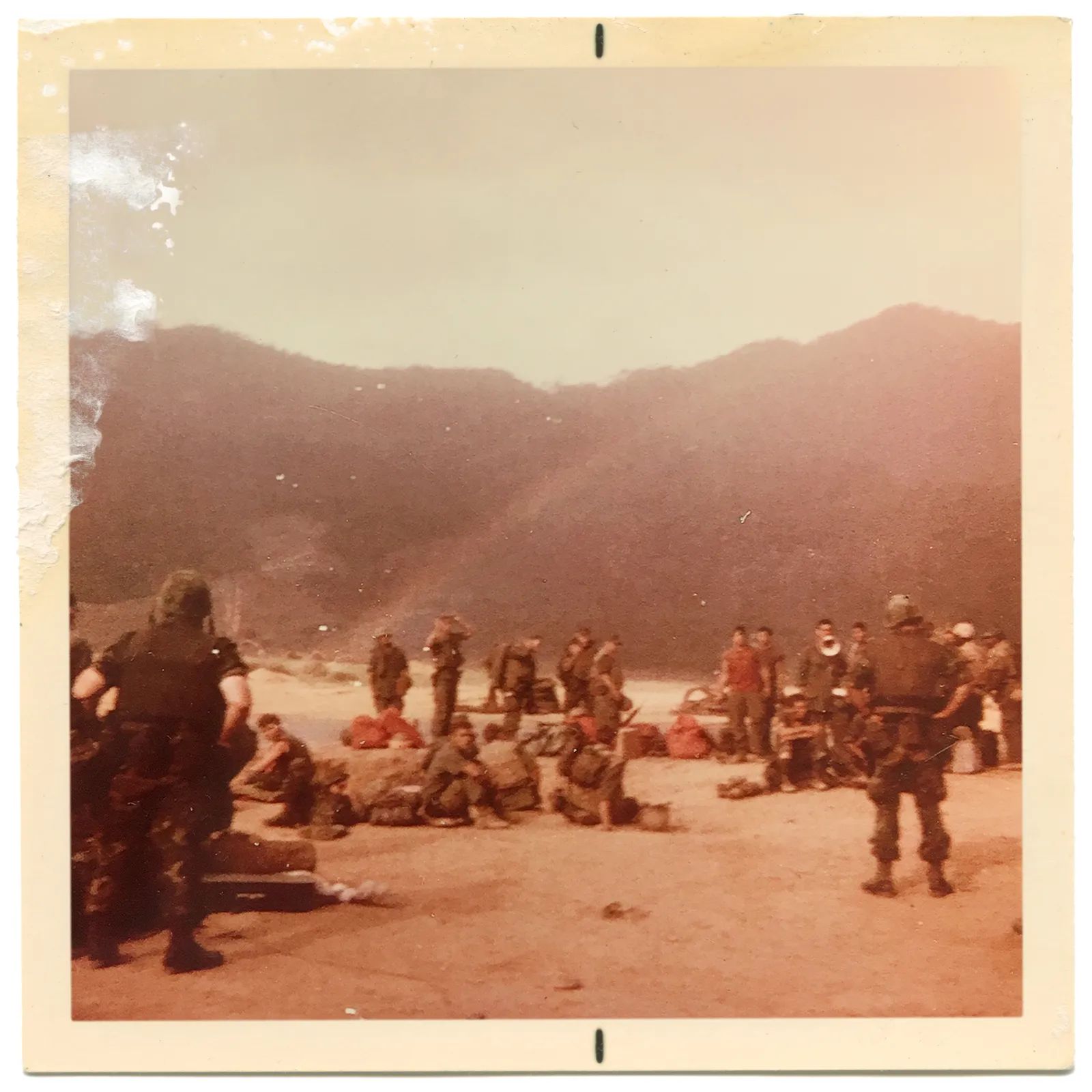
This — contrary to a bunch of what you might see on the internet — is the only known photo of Mueller in combat in Vietnam. Here, at a makeshift landing zone, his unit is getting briefed before being airlifted to join the rest of an ongoing operation. Mueller is standing on the right with his back to the camera. (Photo courtesy of VJ Maranto)
Mueller would end up serving with distinction — earning a Bronze Star in bitter fighting atop Mutter’s Ridge just weeks into his deployment, where he led his platoon in intense combat and helped rescue fellow wounded Marines, and then being shot himself in late April 1969 when his platoon rushed to help another unit caught in fighting. The incoming fire that day was so unrelenting — the stress of the moment so all-consuming, the adrenaline pumping so hard — that when he was shot, Mueller didn’t immediately notice. Amid the combat, he looked down and realized an AK-47 round had passed clean through his thigh.
He kept fighting and would receive the Navy Commendation Medal for his actions that day; another member of Hotel Company was killed in the fight, two others wounded, including one brand new Marine who had his leg blown off by a grenade on his first day in Vietnam. Mueller ended the day being evacuated by helicopter; later, he rotated to a staff position in-country and eventually was reassigned back to Washington. He’d at one point thought he would make a career out of the Marines, but he found, as he later told me, “I didn’t relish the US Marine Corps absent combat.”
But it set him on a path of public service — coming home, he sent off an application to the University of Virginia law school with the goal of serving his country as a prosecutor. “I consider myself exceptionally lucky to have made it out of Vietnam,” he said years later in a speech. “There were many—many—who did not. And perhaps because I did survive Vietnam, I have always felt compelled to contribute.”
Mueller rarely talked about his time in Vietnam, but it influenced everyday of his life. Among the many tributes that poured forth yesterday from people who had worked alongside him or been touched in their own careers by his presence, I was struck by a new-to-me story from Eric Smith, a former FBI executive:
In the middle of the night in December 2010, I was standing next to then Vice Admiral William McCraven at the edge of an isolated camp within Bagram airfield in Afghanistan. We were awaiting the arrival of FBI Director Robert S. Mueller, III, who was touring the Middle East and wanted to meet with the admiral, the CTJTF and FBI staff forward deployed there.
What struck me that evening was the mutual admiration and deep respect between these two leaders. As we stood in the cold, with dust swirling, the scene became even more surreal when a three-car caravan of dark SUVs arrived. Director Mueller stepped out, impeccably dressed in a crisp white shirt, tie, and dark suit. VADM McRaven graciously, albeit unnecessarily raised a salute, which, as I recall, caught Director Mueller by surprise who nonetheless instinctively returned it. A fantastic memory.
Later, Director Mueller was taken to a field hospital within Bagram, where he, a former Marine Officer and U.S. Army Ranger graduate, pinned a Purple Heart on a Ranger who had been shot the night prior during a cave clearing mission against the Taliban. Before the orders were read for the presentation, Mueller shared his own story of being injured in Vietnam, when he was shot through the thigh while running across a ridge line. The Ranger, covered with an occlusion dressing and draped with a camouflage t-shirt, was visibly moved, as were we all. This story was unknown even to his long-time security detail.
* * *
Today, most Americans will remember Mueller primarily for his time as special counsel. It was surely the most controversial chapter of his half-century career. I’m not sure that history is ready to deliver a verdict on his time investigating Trump — I say that as someone who wrote a Watergate book 50 years later and feel like only then were we really able to understand the machinations of Nixon’s White House — but I’ve spent a lot of time talking and thinking about that investigation in the years since, including two or three conversations with Mueller himself.
The investigation led to a stunning series of indictments — exposing the role Russia had played trying to influence the 2016 election and the incredible corruption and criminality inside the president’s own circles, back in an era when the country was more willing and able to be shocked by such revelations about Donald Trump. It should have been a presidency-ending investigation — and I think it’s clear to anyone who is intellectually serious that we never got to the bottom of the rot of Donald Trump’s 2016 campaign nor his obstruction of justice as president in the first term.
But in the end, I think it’s also clear that the Special Counsel’s Office was outplayed in the final chapter of the case by the bad faith of Attorney General Bill Barr, who Mueller had worked with in the 1990s, including on the Pan Am 103 case. Mueller, the most traditional of traditionalists and most institutional of institutionalists, was still operating under a set of rules and norms that no longer existed in Donald Trump’s Washington by 2019 — he thought Barr would release his finished report without additional commentary and believed that, since he was legally prohibited from indicting the president, he had laid the groundwork for a follow-on congressional investigation. As Mueller would later say, “If we had had confidence that the president clearly didn’t commit a crime, we would have said so. We didn’t.”
And yet Barr, before anyone read the report, declared that it exonerated Trump — and Mueller and his team were too shocked and slow at responding. The rules that Mueller had played by his entire life had changed. By the time the actually incredibly damning report was released, the air had gone out of the balloon. Mueller’s own testimony on the Hill that summer was lackluster and underwhelming, as age had begun to take a toll on the once iron-willed prosecutor.
As I told the Washington Post in an interview for Mueller’s obituary back in 2020, “The very qualities that got Mueller appointed and enabled him to push through with the investigation — his reputation as the sole figure in Washington who was above partisanship — turned out to be the qualities that made him stop short of concluding what most people thought he should conclude about the president.”
Even if I’m not sure the final verdict on the special counsel investigation, I am sure that part of the verdict on Donald Trump someday will be how he reacted to Robert Mueller’s death yesterday — I can’t say any of it better than James Fallows, who called Trump’s reaction: “The most despicable public statement by an American public official in my lifetime. It needs to be recognized as such.”
What I most worry about, though, is how the type of person that Robert Mueller was — a dedicated apolitical, nonpartisan public servant, a man more concerned with the good of the country than his own personal profit — represents a literally disappearing breed in Washington and American government.
For years, I had believed that the next FBI headquarters would be named in his honor and known as the Robert S. Mueller Building — but now I worry even more that it won’t be, and all that that failure to recognize his tradition and breed of public service will mean for Washington, the FBI, our politics, and our country.
If the United States is ever to succeed and thrive as a democracy again, we need to find, inspire, train, and elevate the next generation of Robert Muellers. As the longtime intelligence reporter Tim Weiner, who authored Mueller’s New York Times obituary this week, wrote on BlueSky: “We will not see his like again.”
I worry, deeply, that Tim is right.
GMG
PS: If you’ve found this useful, I hope you’ll consider subscribing and sharing this newsletter with a few friends:
P.P.S.: This essay draws upon and quotes extensively, both edited and unedited, from my years of previous writings about Mueller.