- Doomsday Scenario
- Posts
- The 1980s called; they want Trump's Venezuela coup back
The 1980s called; they want Trump's Venezuela coup back

Garrett Graff
January 06, 2026 • Reading Time: 2 minutes
Welcome to Doomsday Scenario, my regular column on national security, geopolitics, history, and—unfortunately—the fight for democracy in the Trump era. I hope if you’re coming to this online, you’ll consider subscribing right here. It’s easy—and free:
I’m following up this morning’s post about January 6th with a rare second-in-the-day newsletter to highlight my new piece in WIRED Magazine today about Trump’s weekend coup in Venezuela, where US special forces invaded the capital and captured/kidnapped Nicolás Maduro.
The raid — itself almost certainly illegal under both international law and US law — was the culmination of months of strangeness by the Trump administration — including that series of also-almost-certainly-illegal military strikes on boats the US said were engaged in drug smuggling that killed more than 100 people. At least some of them — perhaps most of them — were innocent; at the very least, they almost certainly weren’t smuggling fentanyl to the United States, which was the purported reason for the attacks, since fentanyl doesn’t come from Venezuela. (In fact, almost all of the drug-smuggling allegations are at least somewhat off-base.) At least some of the boat strikes appear to be war crimes.
All that time, too, the Trump administration was building up one of the largest naval armadas and military forces the US has assembled in a long time, for reasons unknown.
In my home of Vermont, elements of our Air National Guard were federalized and deployed to the Caribbean just before Christmas, also for reasons unknown.
Now we know why.
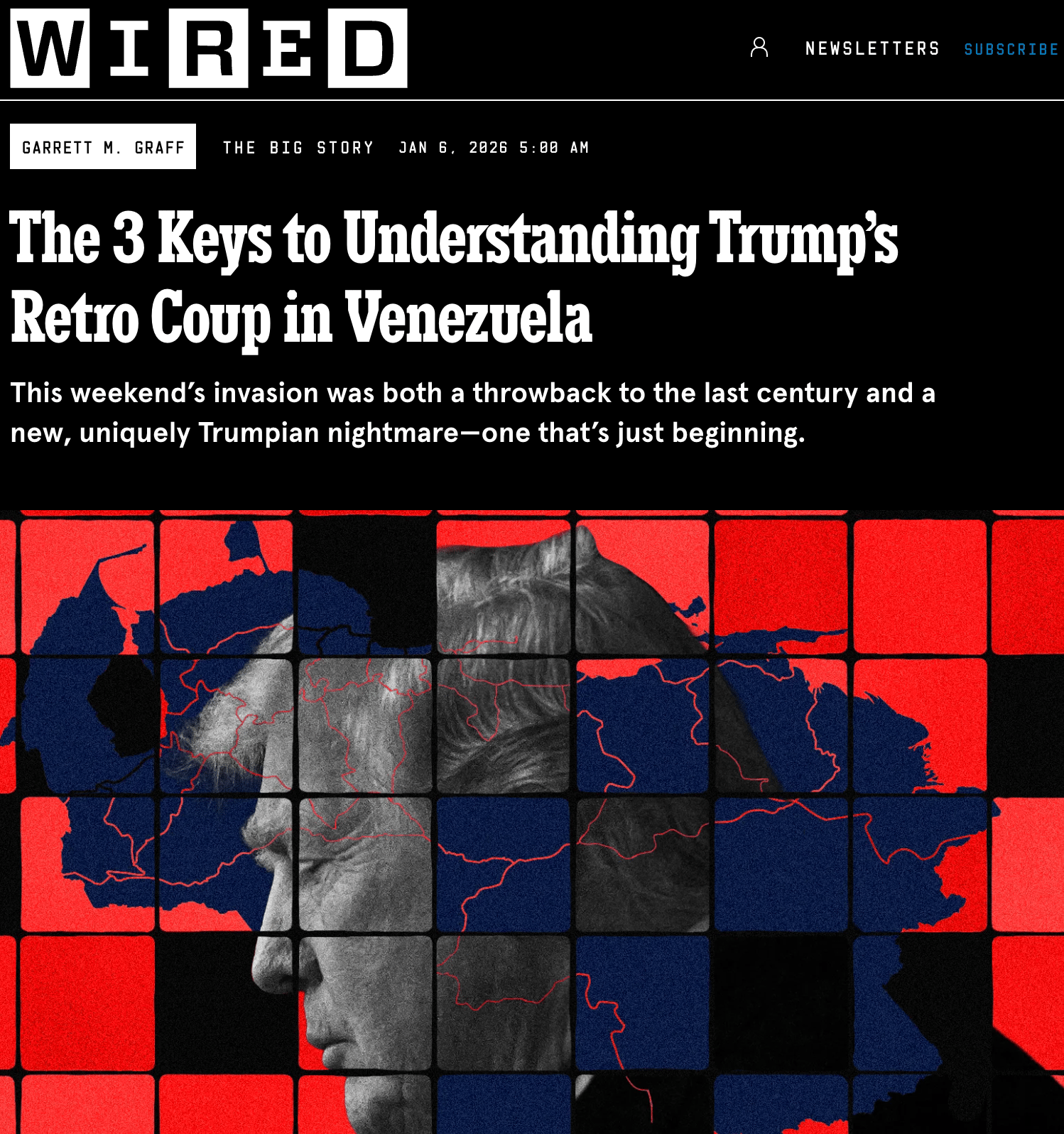
There’s been a lot written about the Venezuelan operation since the stunning breaking news alert on Saturday morning, but in my new essay, I try to lay out how Trump’s foray into Latin American politics brings together two uniquely worrisome historical patterns — Trump’s complete lack of planning with our collective national shameful history across a century of US meddling in Central and South American politics:
For a century, the two chief hallmarks of US meddling in Latin America have been short-term tactical military success and long-term strategic failure. These two themes are, in fact, deep, venal strands of America’s political DNA.
Understanding our history in Latin America is a particularly strange tale of US politics — come for how it ties together Watergate burglar E. Howard Hunt and Robert Mueller. (I’ve long been interested in the US prosecution of Panamanian dictator Manuel Noriega and once actually even ended up in a long lawsuit against the Justice Department, which tried to deny my FOIA for Noriega files by saying he was protected by US privacy law, and I argued that since he was the sovereign head of a sovereign nation when he was arrested, it didn’t seem to follow that he was a “US person.” We won. Thanks Mark Zaid and Brad Moss for that legal representation!)
A big part of the WIRED piece was drawn from my interview in November at the Texas Tribune Festival with former Trump national security advisor John Bolton. You can watch the conversation in its entirety here — I thought it was a really interesting conversation and I, for one, learned a lot from it:
I also want to highlight two books I mention in the essay — both of which made my “best books of 2025” list. If you want some really valuable historical context for this Venezuela operation, I encourage you to read HOW TO HIDE AN EMPIRE by Daniel Immerwahr and EVERYONE WHO IS GONE IS HERE by Jonathan Blitzer. Read them; they’ll make you smarter. And — truthfully — what’s more fun than that?
Happy reading. More soon.
GMG
PS: If you’ve found this useful, I hope you’ll consider subscribing and sharing this newsletter with a few friends: