- Doomsday Scenario
- Posts
- Trump Surprised To Find He's At War in Iran
Trump Surprised To Find He's At War in Iran
Once his not-even-half-baked plan failed to materialize in Iran, it’s clear that there’s no Plan B.

Garrett Graff
March 12, 2026 • Reading Time: 7 minutes
Welcome to Doomsday Scenario, my regular column on national security, geopolitics, history, and—unfortunately—the fight for democracy in the Trump era. I hope if you’re coming to this online, you’ll consider subscribing right here. It’s easy—and free:
The hardest thing for the media to wrap its hands around over the last year is that Donald Trump has no plan — for anything, ever. Time and again, national pundits and the White House press corps invent a logical Donald Trump who sets, announces, and later “changes” real “policies” or “plans,” failing to convey what is clear to anyone who is actually following events closely: In each public appearance and social media post, the Mad King Donald Trump spouts a string of words, devoid of meaning or purpose, that may or may not represent anything at all.
Every single thing he says may, at any given time, be taken as an official hard-line policy of the US government, the opening gambit to a long flexible negotiation, or a random pronouncement that will never be mentioned again. It’s impossible to know in real-time which is which — especially so if you’re actually in the US government and in charge of translating his words into actions and plans.
It was barely two weeks ago, remember, that Donald Trump announced out of the blue that he was sending a US Navy hospital ship to Greenland to provide medical care for “sick” islanders. The Danish and Greenland governments were baffled by what he meant; the US government never even bothered to try to explain the presidential announcement; and, at the time, both US hospital ships were in dry dock undergoing repairs. Let’s check back on that, shall we? Today, there’s only one hospital ship at sea — and it recently transited the Panama Canal and is now off the west coast of Mexico, apparently heading toward a long-term repair and overhaul in Portland, Oregon. There’s been no further mention of Trump’s tweet. The entire episode just came and went, as baffling as ever.
I mention the hospital ship because the US is now two weeks into running a major regional and global conflict with the same level of haphazard statements, strategy, and planning — and the US media continues to cover Trump as if he actually has some semblance of a plan or strategy for what to do in Iran, a country he’s clearly already bored with invading but now has created such an international crisis that he can’t quite just walk away as he’s become used to doing. This is TACO Trump at his most dangerous.
The administration never had any real justification for its war with Iran — and, indeed, it has offered something like 10 “ex post facto” justifications. But leaving aside why we went to war, it’s even less clear what victory looks like. Every day this week — and sometimes multiple times a day — Donald Trump has offered shifting statements, declaring the war somewhere between “very complete” and “not enough.” Each utterance has generated headlines as if they shed any light on the overall trajectory of the war, which might last anywhere from a few more hours to “four to five weeks” to, say, sometime in September, if you believe the timeframe that US Central Command is recruiting additional intelligence support.
It’s clear that none of Trump’s statements are operative — or even necessarily insightful in any way. The war will continue right up until the moment it doesn’t.
But what’s become even more clear in the two weeks since is that Donald Trump doesn’t understand — and isn’t remotely interested in understanding — the reality of the situation in Iran. The administration’s entire gamble appears to be that Iran would be Venezuela — they could conduct a single night of strikes, decapitate the leadership, and then through geopolitical magic a Delcy Rodríguez figure would emerge to lead Iran peacefully and cooperatively.
Now that not-even-half-baked plan has failed to materialize, it’s clear that there’s no Plan B. Quite the contrary — we seem to have a US government that wakes up each day completely befuddled and surprised to find it’s involved in a conflict in Iran.
Instead, we have a government that has been repeatedly surprised by the most basic and foreseeable consequences of its own actions — like Marco Rubio’s days of stumbling over how the US had no plan for evacuation flights for Americans caught up in the fighting across the Middle East and their belated planning efforts to reduce gas prices.
As Michael McFaul noted on Twitter, “Reporting tells us that there is no real National Security Council-led inter-agency process operating in the Trump administration. They don't even have a full-time NSA! So that probably explains why: (1) the mission of the war is ill-defined, (2) the comms roll-out was a mess, and (3) they didn't think of all the second and third order effects of war because that memo was never written, let alone discussed in the [White House Situation Room], as would be the tradition of any past administration, Democratic or Republican.”
The new New York Times tick-tock of the Trumpian miscalculations that led us here is eye-popping: “Inside the administration, some officials are growing pessimistic about the lack of a clear strategy to finish the war. But they have been careful not to express that directly to the president, who has repeatedly declared that the military operation is a complete success.” That does not sound like a conflict that is going well — or likely to turn around anytime soon. (That of course is leaving aside the week’s other big story: The top figures of the administration are apparently walking around in ill-fitting shoes because they’re too embarrassed to tell Donald Trump their correct shoe size — and that Pete Hegseth so disliked how he looked in press photos briefing at the Pentagon that he’s no longer allowing photographers into his briefings — again, all signs of a smooth, well-functioning team!)
Most of all, it appears Donald Trump doesn’t understand the Strait of Hormuz — the narrow chokepoint at the end of the Persian Gulf that even high school Model UN players understand is vital to the functioning of the world economy and oil exports. He has been shocked and surprised by Iran shutting the chokepoint to oil tankers — and so completely shocked that Iran is now attempting to mine the Strait that the US actually pulled its minesweepers out of the Gulf just weeks ago after literal decades of deploying them there to counter this very threat. (Don’t worry: The US Navy has four other minesweepers — in Japan!)
Trump’s latest effort to reopen the Strait, to basically have the US act as the insurer of last resort, turns out to be “easier said than done,” according to the Wall Street Journal, since the US doesn’t actually know anything about the insurance market — led by Lloyd’s of London — it is trying to now underwrite.
What’s surprising to me, though, is that the news media is covering all of this uncertainty and sham-handedness as if it’s all part and parcel of a normal conflict. I’ve written time and again since Trump took over about how the media knows the difference between covering a “new story” and a “news event.” The US “chaotic withdrawal from Afghanistan” was a news event. So far, the war with Iran continues to be covered as a “big news story.”
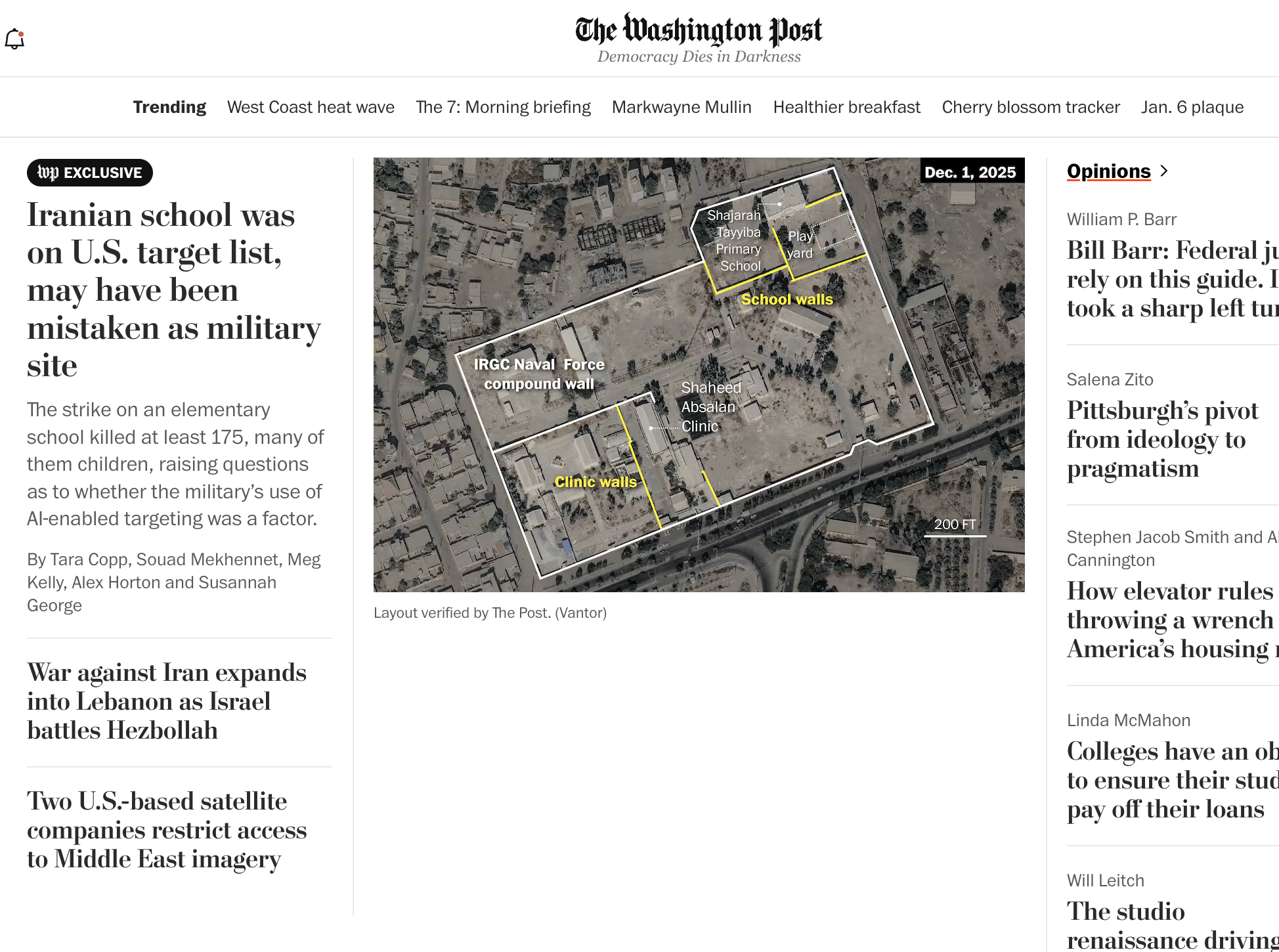
This is the front page of the Washington Post this morning — no banner headlines, no major blaring alarm bells, just routine coverage of something that’s not a war:
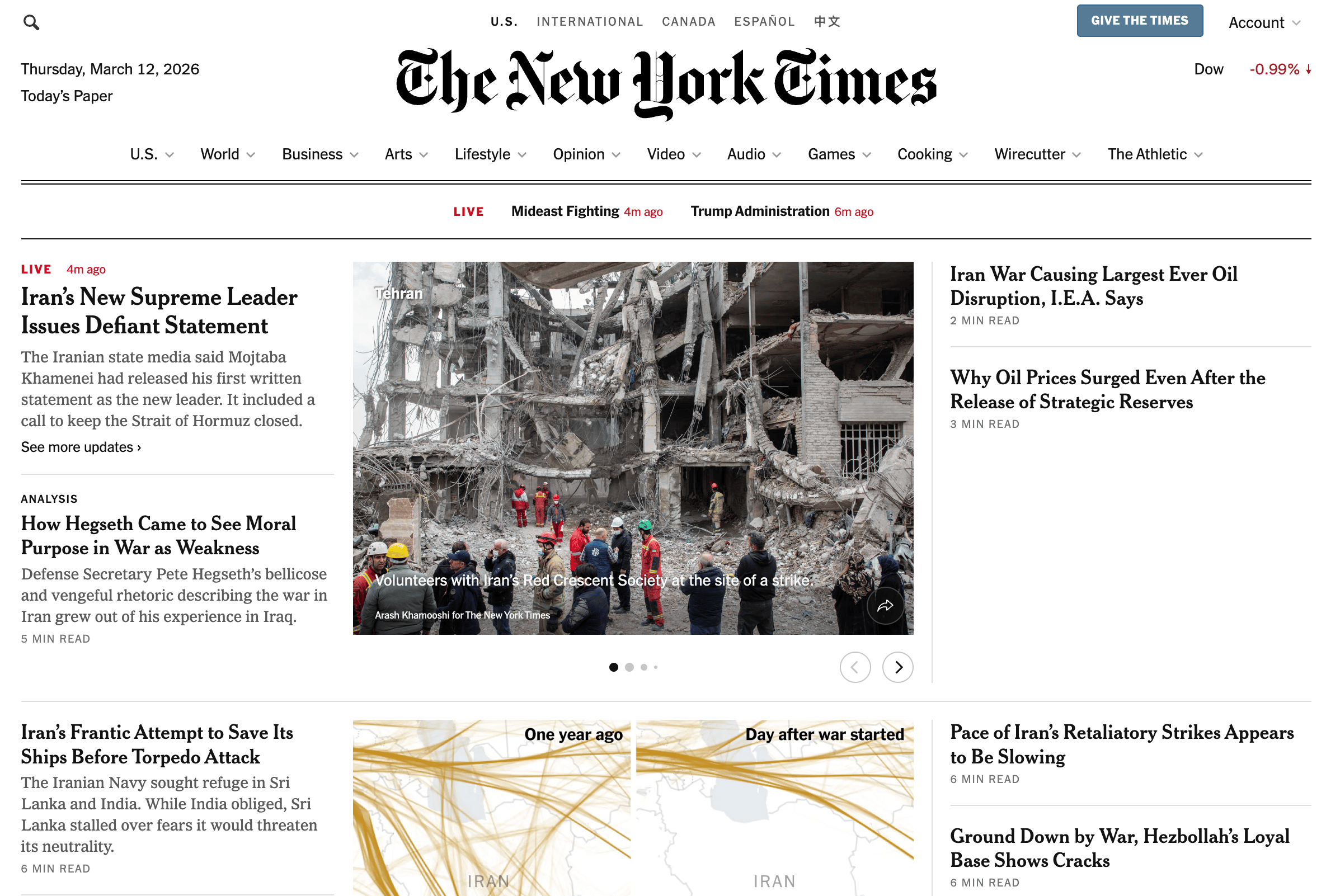
This is the New York Times today:
This is CNN.com:
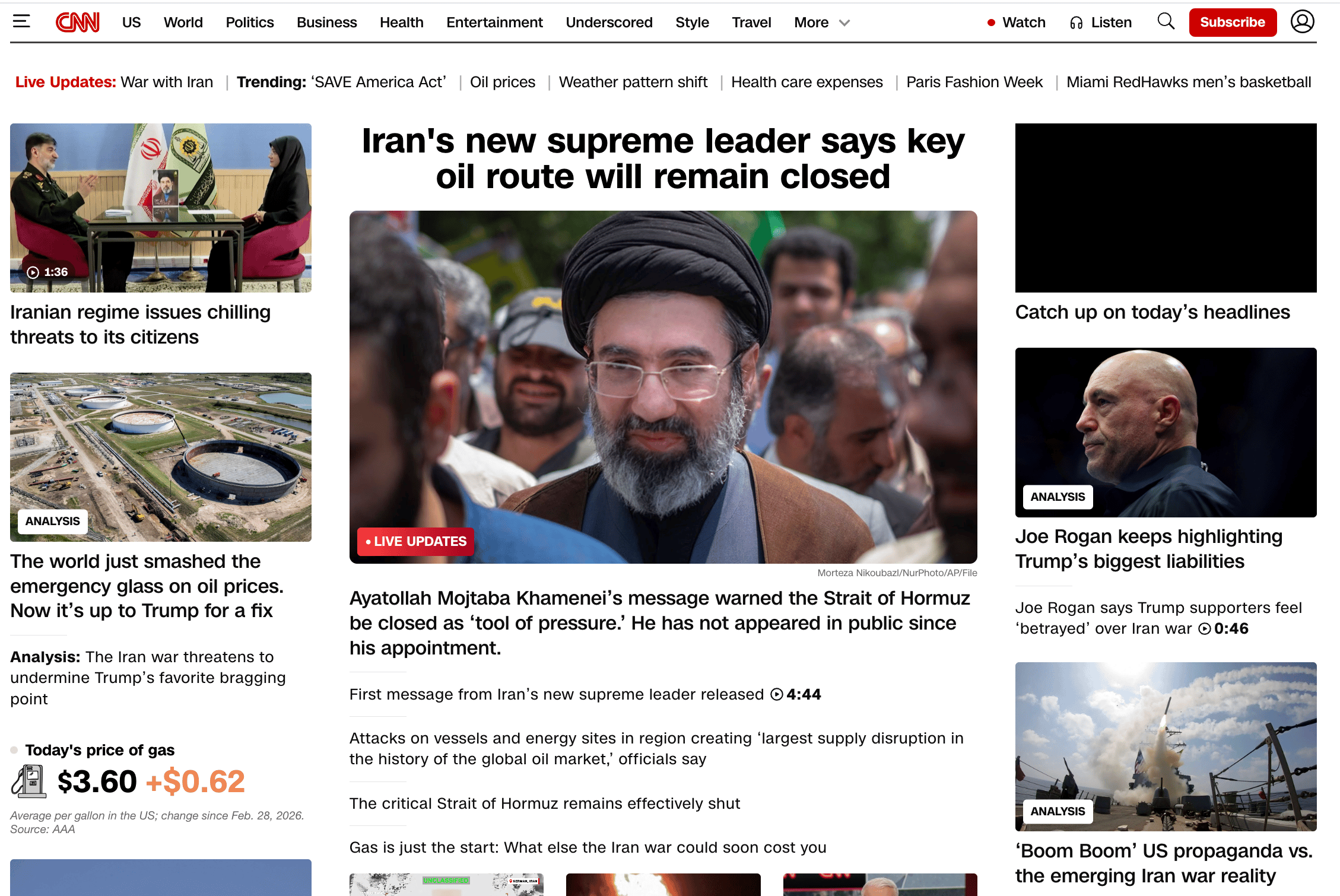
Notice anything missing? There’s nothing in any of these homepages that makes clear how lost the US is — nor any particular sense of urgency or banner headline.
I wish the media would start to trumpet what seems clear to anyone actually reading the media’s own coverage: Every news story needs to start leading with the fact that Trump is lost at sea.
He has somehow stumbled his own way into a disastrous foreign war-of-choice with profound economic and geopolitical consequences likely to unfold for decades to come and rebound terribly on the United States and across the Middle East. It is a mistake of such epic proportions that the Bush administration’s war in Iraq appears increasingly likely to turn out to be America’s “best” war in the Middle East of the 21st century.
I want to focus, too, on another point — the cost of a war.
The Pentagon is telling Congress today an initial, partial tally of the monetary cost of the war (the cost in human lives, instability, and reputation is of course much higher): The first week of the war cost about $11.3 billion — an enormous number that is hard to even tally. To put that in context: It’s a number larger than the annual state budget of some 16 states, including Iowa or New Mexico and represents roughly the entire annual state budget of Nebraska, Oklahoma, or Alabama.
More than that, though, is how we as a nation spend money on war and “immigration enforcement” as if it’s endless, while skimping on all the expenses that actually help our fellow humans. We have already added this past year $150 billion to the defense budget — while destroying and dismantling the $35 billion we spent on the US Agency for International Development. As I wrote and investigated a couple weeks ago, the $52 billion construction and procurement budget for Customs and Border Protection is so large that it represents more than the defense budgets of Hungary, Austria, the Czech Republic, Switzerland, Finland, Greece, Belgium, Romania, Denmark, and Norway combined.
The remaining money to spend this year that CBP has to spend equals the entire GDP of Estonia.

I think a lot in moments like this of the 1953 speech by Dwight Eisenhower about the cost of war versus peace.
“Every gun that is made, every warship launched, every rocket fired signifies, in the final sense, a theft from those who hunger and are not fed, those who are cold and are not clothed,” Eisenhower told a group of newspaper editors. “This world in arms is not spending money alone. It is spending the sweat of its laborers, the genius of its scientists, the hopes of its children. The cost of one modern heavy bomber is this: a modern brick school in more than 30 cities. It is two electric power plants, each serving a town of 60,000 population. It is two fine, fully equipped hospitals. It is some fifty miles of concrete pavement. We pay for a single fighter with a half-million bushels of wheat. We pay for a single destroyer with new homes that could have housed more than 8,000 people.”
What could $11.3 billion have bought us if we spent it here at home? A few data points: We spent in the 2020-2021 school year a total of about $21 billion to feed near universal school lunches and breakfast across the country during the pandemic — a life-changing educational investment for children. Or today: $11.3 billion would cover putting 1.4 million on Medicaid or into affordable housing — that’s the entire population of New Hampshire or Maine.
Remember all of this the next time you hear a politician tell you there’s not enough money for this social safety program or that one.
It’s never that there’s not enough money.
It’s that they don’t want to spend it here to help people.
Spending money on war and border security is a choice.
GMG
PS: If you’ve found this useful, I hope you’ll consider subscribing and sharing this newsletter with a few friends: