- Doomsday Scenario
- Posts
- Watching A Superpower Die By Suicide
Watching A Superpower Die By Suicide
This is one of the wildest moments in all of the modern 400-year history of nation-states and geopolitics.

Garrett Graff
January 22, 2026 • Reading Time: 4 minutes
Welcome to Doomsday Scenario, my regular column on national security, geopolitics, history, and—unfortunately—the fight for democracy in the Trump era. I hope if you’re coming to this online, you’ll consider subscribing right here. It’s easy—and free:
First, a couple of programming notes. I always encourage shopping at your local independent bookstore, but if for whatever reason, you’ve been waiting to get my latest book, THE DEVIL REACHED TOWARD THE SKY, or my oral history of D-Day, WHEN THE SEA CAME ALIVE, Amazon is having a tremendous sale right now on both right now — the hardcover of the oral history of the Manhattan Project is just $14 and the D-Day hardcover is just $15. It’s going to be cold and snowy this weekend across much of the eastern US, why not lay in a couple extra books for security and coziness?
Second, speaking of indie bookstores, if you’re in and around Vermont and want to brave the (moderate) cold tomorrow (Friday) night, I’ll be interviewing Cynthia Miller-Idriss at Phoenix Books in Burlington at 7 pm. Cynthia’s a fabulous writer and thinker on extremism and has a new book Man Up: The New Misogyny and the Rise of Violent Extremism that explores the gender dimensions of our modern moment of far-right extremism and the “Manosphere,” a subject which I also explored with the also-amazing scholar Donna Zuckerberg in the final episode of the latest season of LONG SHADOW. (Which, by the way, was nominated yesterday for a total of three “Ambies,” the Academy Awards of the podcast world, including “best tech and science” podcast, “best news & politics” podcast, and, amazingly, “best nonfiction scriptwriting,” which is quite something. Give it a listen if you haven’t.
Now onto the week’s wild news:
Across the first three weeks of 2026, and especially yesterday, President Trump’s Mad King rantings about Greenland have accelerated into something far more stunning and alarming: We are watching in real-time as a superpower dies by suicide — an all-but unprecedented choice to self-immolate and torch the country’s remaining global trust and friendships.
The entire world order we built across eighty years, a never-before-seen geopolitical success that has been tended and fostered by Republican and Democratic administrations across a dozen presidencies, has been sacrificed this week on the altar of Donald Trump’s legacy-mad narcissism. There’s some reason to believe today we won’t end up in a war against NATO for Greenland, but regardless the speeches out of Davos this week make clear that the western world is turning its back on the United States. The damage is already done.
I dove into all of this today in my new WIRED “Big Story,” out this morning, about this incredible week in geopolitics:
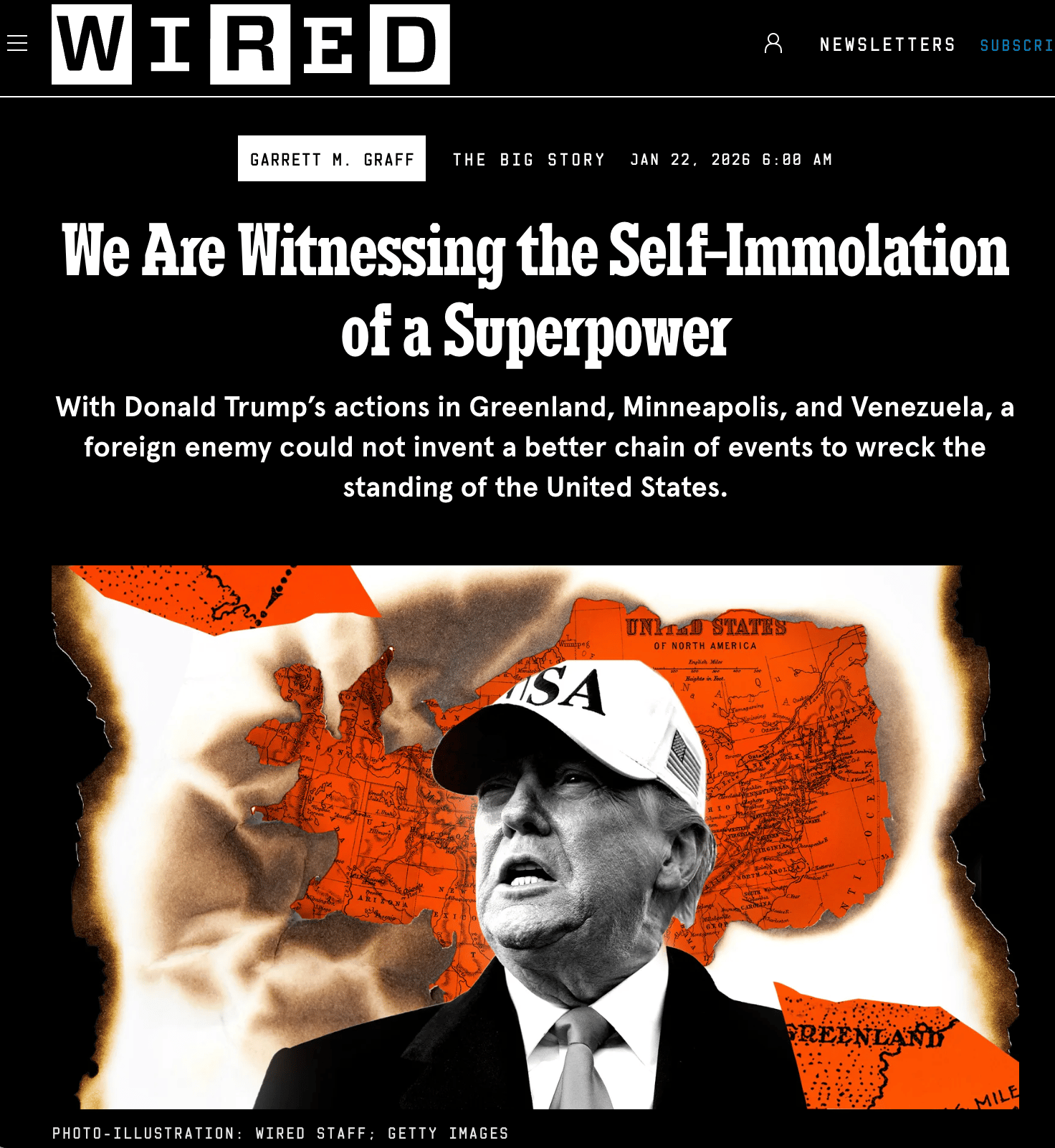
To watch the push for Greenland is to experience one of the wildest things that any country or head of state has done in the entire history of the modern world, dating back to the very creation of the nation-state era in 1648 with the Treaty of Westphalia. It is hard, in fact, to find any geopolitical parallel. Countries and leaders have certainly made choices and mistakes that ended in ruin—there’s Napoleon setting out to invade Russia or the actions of the Austro-Hungarian empire at the start of World War I—but it’s impossible to think of a single moment when a country so thoroughly set about consciously dismantling its core sources of national strength and influence.
In the WIRED piece, I try to get at what made the American order work over the last 80 years and the unique way that Donald Trump has set about dismantling and attacking all six of the policy pillars on which we’ve built so much security, success, and wealth:
For the 80 years since the end of World War II, the US model of innovation, trade, and economic hegemony has been built on a foundation of six seemingly inviolable traditions and policies held steady across both Republican and Democratic administrations: (1) easy access of immigrants to the US, particularly its unparalleled world-class schools and universities; (2) rich and steady government support of higher education, medical research, and laboratories; (3) broad and ever-more-frictionless trade access to US markets and, reciprocally, a flow of US products to the rest of the world; (4) a firm, unyielding, and unquestionable adherence to the rule of law at home that made the US a predictable and safe place to create, build, and do business at home; and (5) a similarly firm, unyielding, and unquestionable network of geopolitical alliances abroad that knitted together a security blanket that stretched around the entire globe, backed up by the most powerful and widest-ranging military ever seen in human history.
All five of those pillars helped firm up and underpin another equally critical pillar: (6) a politically independent and fiscally prudent monetary policy that established the US dollar as the world’s safest reserve currency. This made US Treasury bonds the savings bank for the entire world—for democracies and authoritarian regimes alike!—and made US banking networks and capital markets the place to be for any company looking for access to investors.
It’s entirely unclear where any of this stands today. By the end of a very eye-popping day in geopolitics and international relations yesterday, something had changed. For now, Donald Trump has blinked and backed away from the edge. He announced that he reached the “framework for a future deal” with NATO’s secretary-general and wouldn’t move forward with raising tariffs on Europe on February 1st.
But what does that mean? No one knows. It may, evidently, involve giving the US sovereignty over some land for military bases — but we already had the chance to build as many military bases in Greenland as we wanted. We were the ones who have steadily closed bases across Greenland in recent decades.
Plus, I would caution that there are plenty of reasons to doubt any real deal; in the press reports about the pause, Denmark wasn’t commenting, nor was it clear Danish officials even knew what Trump was talking about, and it didn’t appear that Greenland officials knew anything. My guess is that this is far from over over.
One thing that is important to remember — and worthy of hope — is just how wildly unpopular Donald Trump’s Greenland foray has been. A military invasion of Greenland polls at just four percent — in a country where, as I say, roughly 13 percent of people believe in Bigfoot. At least for now, Americans still understand true insanity when they see it.
GMG
PS: If you’ve found this useful, I hope you’ll consider subscribing and sharing this newsletter with a few friends: