- Doomsday Scenario
- Posts
- "ICE 101" — How Trump changed ICE and CBP into a fascist secret police
"ICE 101" — How Trump changed ICE and CBP into a fascist secret police
ICE and CBP are fatally flawed products of the post-9/11 War on Terror — now Trump has weaponized those very flaws to occupy America.

Garrett Graff
January 20, 2026 • Reading Time: 16 minutes
Welcome to Doomsday Scenario, my regular column on national security, geopolitics, history, and—unfortunately—the fight for democracy in the Trump era. I hope if you’re coming to this online, you’ll consider subscribing right here. It’s easy—and free:
It’s sometimes hard to capture just how far through the looking glass we are in American politics and daily life, but here’s one snapshot: I was on Audie Cornish’s CNN show last Thursday morning, which I always try to do when I’m in Washington, D.C., and at the time I went to bed the night before, we were prepping to talk about some combo of the following: The US takeover of Venezuela and Donald Trump’s meeting with its opposition leader, who may or may “award” him her Nobel Peace Prize later that ay (she did); the fact that the US may or may not launch military strikes in Iran; and how the US may or may not be moving toward a military invasion of Greenland.
But then when we actually got to set Thursday morning, we spent a lot of the show discussing how there was another federal shooting in Minnesota, during the paramilitary occupation of the third-largest metropolitan region in the Midwest by a presidential secret police sent there to terrorize local communities.
If you’re feeling like the news is a tsunami right now, you’re not wrong. If you’re feeling like the heaviness of the world is a literal weight on your shoulders, you’re right.
Right now, there are 3,000 ICE officers and CBP agents on the ground in Minnesota — a number that dwarfs the ten largest local and state police agencies there combined. It’s an insane use of federal resources.
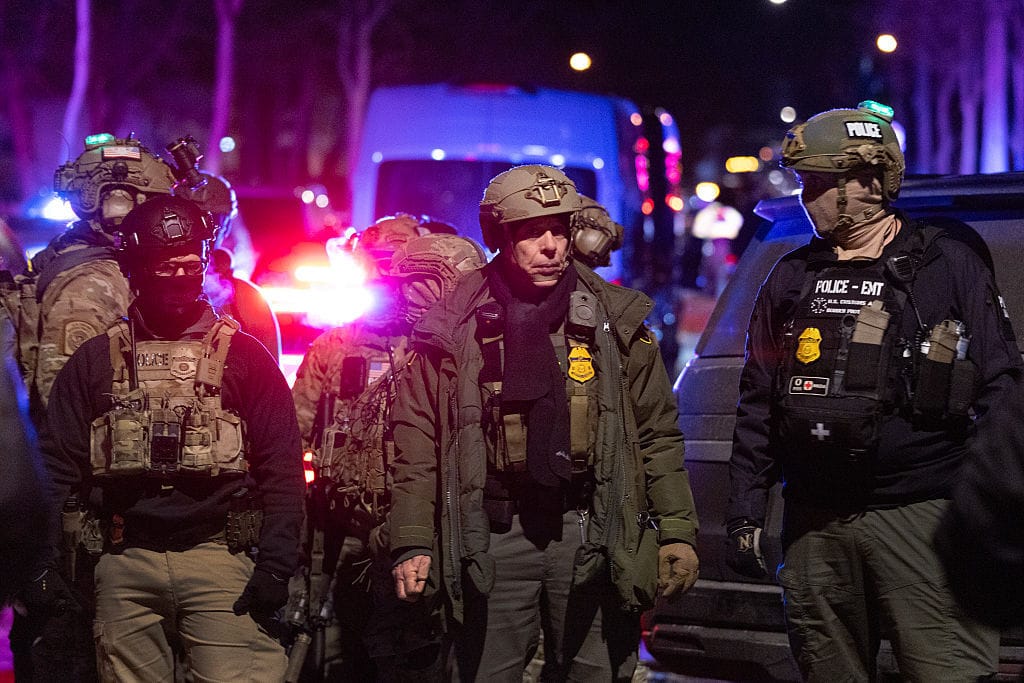
Border Patrol chief Gregory Bovino at the scene of a late Wednesday night shooting by an ICE officer in Minneapolis. (Photo by Scott Olson/Getty Images)
On Saturday on Ali Velshi’s MS NOW show, I talked about a regular theme of mine since August: This is what fascism looks like — there is no bright line between democracy and autocracy, it’s a spectrum, and not all of the country will experience that switch at the same moment in the same way. But let’s be clear: There is a US city living under occupation by fascist presidential secret police right now.
The brutality of the occupation in and around Minneapolis — scenes from the Global War on Terror transplanted from Kabul or Baghdad to Minnesota — has a lot of people asking basic questions about ICE and CBP, so I thought I’d devote today’s column to trying to explain what ICE and CBP are and what they aren’t, what powers they have, and what’s changed in America to bring this war to our streets.
First, an important caveat: Throughout the explainer below, I’m making some broad generalizations, understanding and recognizing that there are important nuances, exceptions, and special cases. One of the evil superpowers of Donald Trump is how he makes you defend or long for institutions that weren’t ideal in the first place. CBP and ICE in the Obama or Biden years — or even the first Trump term — were by no means perfect nor deeply humane organizations that always respected civil rights and liberties. There are plenty of CBP and ICE horror stories from its first two decades. (I’ve written about dozens of them.) Many families, people, and communities suffered trauma and abuse in ICE detention operations or facilities. And yet: ICE and CBP managed to go about their work in such a way that didn’t cause ordinary law-abiding US citizens to fear for their lives; the entire school systems of major US cities didn’t have to close in fear of CBP and ICE operations targeting neighborhoods and after Border Patrol agents battled with high school students on school grounds. And, most notably, for most of that time ICE actually deported as many people (or sometimes more!) than Trump has historically managed to do as president.
Something material has changed in this second Trump and I want to help you understand what it is. (If you’d prefer to listen to me talk about this, I explained some of this below on Crooked Media’s “What a Day” podcast yesterday.)
The Basics — Understanding the Immigration Org Chart:
There are two different federal agencies causing chaos in Minneapolis and other major cities — Immigration and Customs Enforcement (ICE) and Customs and Border Protection (CBP). As much as everything is now being labeled “ICE,” many of the viral video clips and brutal assaults are actually primarily the work of CBP strike teams led by Gregory Bovino, who I’ve in the past compared to a Confederate cavalry commander. (Before last year, Bovino was a mid-level DHS official, one of about a score of “sector chiefs” in the Border Patrol — but since Trump took over, he’s become something of a roving raid-leader-at-large.)
Both agencies are brand new creations of the post-9/11 world — but they have very different missions, histories, and authorities, which are important to understand.
First, ICE.
There are two (traditionally) very different halves of ICE: What are known as the “Enforcement and Removal Operations,” aka deportation officers, who are among the least trained and educated law enforcement in the US government, and “Homeland Security Investigations,” more specialized and highly trained “special agents,” akin to the FBI or Secret Service, who handle complex “transnational” and national security smuggling cases — think nuclear nonproliferation, antiquities smuggling, child pornography cases, and other very serious and legitimate crimes. HSI does some great work, and as a nation, we should be glad they’re on the watch.
The two halves of ICE have been in deep tension since the agency’s creation two decades ago.
To understand the fatal flaws in ICE and CBP as organizations, you have to go back to their founding. The below has some government alphabet soup to it, but it’s important context to understanding who and what Americans now face on their streets and in their communities.
On September 11, 2001, immigration was the purview of Immigration and Naturalization Services (INS), which was composed of five distinct divisions: Special Agents; Deportation and Detention; Inspectors; Adjudications (aka benefits); and the Border Patrol. Similarly, the US Customs Service dealt with both legal trade and travel (inspectors) as well as smuggling investigations (special agents). INS was a long troubled and understaffed agency, but the nail in its coffin came six months after 9/11 when the agency notified an Florida flight school that two of the 9/11 hijackers had been approved as students for flight training.
As part of the creation of DHS and the massive reshuffling of government, both INS and Customs were broken apart. ICE brought together the “legacy INS” deportation and detention officers, which were renamed as ERO, as well as the “legacy INS” and “legacy Customs” special agents to form the Homeland Security Investigations division. (There’s a famous story that veterans of the DHS creation battles tell about how HSI actually tried at first to name itself the “Bureau of Investigation,” until the FBI went bonkers at the suggestion.)
Other parts of INS and Customs were reshuffled into the new, supposedly “unified” border agency of Customs and Border Protection (CBP). The green-uniformed Border Patrol were in charge of patrolling the border in between legal ports of entry while the blue-uniformed Office of Field Operations handled legitimate trade and travel through “ports of entry” like land crossings, seaports, and airports. (There was also the tan-uniformed division known as Air and Marine Operations, AMO, who handled the boats, helicopters, and planes for patrolling the border.)
CBP was then turbocharged by a post-9/11 Bush era hiring surge that went disastrously; even by the early 2010s, there were warning signs that the Border Patrol, especially, was out of control as an agency — shooting and killing people in sketchy circumstances. As I wrote way way back in 2014, “An internal report [in 2013] that the agency tried to keep secret accused its agents of shooting their weapons not out of fear for their lives but instead out of ‘frustration.’”
ICE, meanwhile, spent much of the next 20 or so years as a relatively low-profile agency struggling to get brand recognition, despite even then being the third-largest federal law enforcement agency. (I wrote a big piece about it in 2012, back when it had a very normal and mostly technocratic Justice Department alum as director, and Barack Obama was being called “deporter-in-chief” because he was actually deporting more people than George W. Bush.)
Throughout its history, ICE has been beset by tension between ERO and HSI, who want to be seen as the elite investigators they are and want nothing to do with the knuckle-dragging and controversial immigration enforcers. ERO and HSI mostly retained separate offices in major US cities, and in one eye-popping rebellion in 2018 during the first Trump administration, the special-agents-in-charge of the majority of the HSI field offices signed a letter requesting the agency be split apart. In part, the HSI leadership explained that the controversy around ERO’s operations was a drag on their morale and public profile, “caus[ing] confusion with the public, the press, other law enforcement agencies, and lawmakers.” The letter was blunt: We, HSI, do good important work and we’re being unfairly maligned by being linked to those unhinged lunatics deporting immigrants.
The Basic Problem, aka “1801s vs. 1811s”:
Understanding both ICE and CBP requires starting with the difference between two US government “job codes,” known as “1811s” vs. “1801s.”
So-called “GS-1801s” are the federal government’s street cops — the bottom ranks of law enforcement, classified in the federal employment system as “General Inspection, Investigation, Enforcement, and Compliance” positions. The positions come with less training and lower education requirements — usually only a high school degree or equivalent — as well as more limited authority.
All of CBP, including both the Border Patrol and Office of Field Operation, are “1801s,” as are all ICE ERO deportation officers. They are authorized to enforce immigration laws and, notably, only authorized to make arrests for federal crimes “if the offense is committed in the officer’s presence, or … if the officer has reasonable grounds to believe that the person to be arrested has committed or is committing such a felony.”
Then there are the “GS-1811” positions, known as “Special Agent / Criminal Investigator.” These are the government’s detectives — think the FBI, Secret Service, US Marshals, and, notably, HSI agents. These positions usually require more work experience and a college degree (most FBI agents in fact have advanced degrees, either law degrees or accounting degrees), and come with far more training (months, not weeks), and more broad investigative authority.
1811s are the government’s detectives.
The difference between 1801s and 1811s may seem minor, but it’s incredibly important in federal law enforcement powers. And it matters, particularly, in understanding why CBP and ICE are as rogue and poorly trained as they are.
For one thing, since CBP was entirely set up as 1801s, that inadvertently meant that it had no authority or power to investigate wrongdoing by its own agents and workforce — to make that point more sharply, in the post-9/11 reorganization, we created the nation’s largest federal law enforcement agency and didn’t give it the power to have the internal affairs capacity that one would expect at even a mid-size local police department.
That helped enable the now-two-decade-long tidal wave of corruption, crime, and misconduct that has swamped CBP since its 2000s era hiring surge. As I wrote in 2014, “There were 2,170 reported incidents of arrests for acts of misconduct, such as domestic violence or driving under the influence, from 2005 through 2012—that’s nearly one CBP officer or agent arrested for misconduct every single day for seven years.” By 2018, that pace had only slowed to one agent or officer arrested every 36 hours.
And this is an ongoing problem: Just last month here in my hometown, we had a former Border Patrol agent sentenced for having more than 350 images of child sexual abuse material on his phone while serving as an agent.
ICE has all of its own problems — just three weeks ago, a detention officer at an ICE facility in Louisiana pleaded guilty to raping a Nicaraguan detainee for months. And an off-duty ICE officer who shot and killed a man in L.A. on New Year’s Eve had been accused of “allegedly whipp[ing] his sons with a belt and ma[king] racist and homophobic remarks in the past.”)
Overall, CBP’s arrest and misconduct rate is FIVE TIMES higher than other federal law enforcement agencies — and, in fact, if you look over the last decade, the arrest rate of CBP officers and Border Patrol agents (.5%) has been HIGHER than the arrest rate of undocumented immigrants in the United States (.4%).
To frame that a different way: In rough terms, the workforce of CBP officers and Border Patrol agents commit crimes at an equal or even greater rate PER CAPITA than the population of undocumented immigrants do in the United States. And, we are now in the process of repeating all of the same mistakes we made with the CBP hiring surge with ICE’s new hiring surge, which is going disastrously so far.
Which brings me to the next major point to understand: If ICE and CBP seem completely unprepared and untrained for their current operations, there’s a reason: They’re not prepared or trained for it!
The Tactic Change:
For nearly 20 years, ICE’s ERO side relied upon and focused heavily on what “prosecutorial discretion.” That meant — generally speaking, and again with the all caveats above — that if you were an undocumented immigrant but weren’t on the government’s radar, you didn’t have to worry much in your day-to-day life. If you were established in your community, you didn’t commit crimes, you weren’t in deportation proceedings, and/or if you kept up with your court dates and paperwork while you were in the asylum hearing, green card, or visa process, you didn’t for the most part have to worry about ICE snatching you at a traffic light, school drop-off, or frog-marching you out of your US citizenship test.
That “discretion” came because DHS officials in both Republican and Democratic administrations knew that there were far more undocumented immigrants in the country than ICE ERO could target — or that Congress budgeted ICE to target — and so they wanted to smart about how they deployed those resources to benefit the country.
ICE ERO mostly focused on either people with a so-called “final order of deportation,” who had exhausted all the legal process, or people with criminal records above and beyond simply being undocumented — e.g., the much-talked murderers, drug smugglers, gang members, rapists, and the like who are always cited as the Trump administration’s main targets. They also relied often on local authorities to flag and turn over undocumented immigrants caught up in local and state jails.
What that “prosecutorial discretion” meant was, in general terms, ICE ERO officers woke up in the morning knowing their target for the day — the name, the criminal record, and legal status. It was often a multi-day (and sometime multi-week or -month) investigation and pursuit.
That work was manpower intensive — the people ICE ERO were pursuing didn’t want to be found — and it also meant that they were making a real difference in terms of crime in the United States. They were actually finding, arresting, and deporting the “worst of the worst,” while, for the most part, leaving the day-laborers and abuelas alone.
Today, all of that is out the window. The moment that Stephen Miller set his “3000 arrests a day” quote last spring, ICE and CBP had to abandon any pretext of doing targeted enforcement operations; it took too long and required too many officers.
Now ICE officers are cruising the streets of America without any idea who they’re looking for — they’re conducting “Kavanaugh Stops,” profiling people of color anywhere they dare show their face in public. Heavily armed CBP agents, meanwhile, are raiding Home Depot parking lots to round up day laborers because it’s the low-hanging fruit of immigration enforcement.
Today, most of CBP and ICE’s operations around the country are conducted with no idea who they might end up finding and arresting. In one very disturbing video from Minneapolis, a Border Patrol agent accost a US citizen because of his accent and then handcuff him in front of his daughter before later releasing him — the dark irony is that the Border Patrol agent himself has the same accent!
This is not how ICE has traditionally been used, and CBP wasn’t supposed to be routinely policing the streets and cities of America’s interior. Which brings me to the next major point:
The Mindset and Training Problem:
We are watching ICE and CBP engage in a national, presidentially-sanctioned police riot — but make no mistake: It’s a riot borne of their fear, not their strength. These agents and officers are terrified about the public hostility they’re facing.
Much of that — both how badly they’ve bungled these operations so far and how badly the public is reacting — stems from the fact that ICE and CBP just aren’t trained for this.
ICE and CBP are not some elite “Seal Team Six of Immigration.” Far from it.
Even before ICE cut its training schedule to just 47 days last year — a length, remember absurdly chosen to honor Donald Trump as the 47th president — ICE’s “1801” deportation officers were among the least educated and least trained federal law enforcement in the country. Other federal agents and law enforcement joke that the quality of the average ICE officer is so low that they are hired “by the pound, from the pound.” CBP is better trained, but only marginally; most 1801 positions only require high school graduates, not a college degree like a traditional “1811” job with the FBI or Secret Service.
Many recruits for both agencies come from the military, but generally after only short careers that don’t go very far. As Chad Loder wrote, “ICE and Border Patrol are easy jobs for people who did their ‘four and the door’ military service…. Usually guys with low ambition and drive who didn’t advance, and with an MOS that doesn’t prepare them well for civilian jobs. There’s a large percentage of ICE and Border Patrol recruits with prior military or law enforcement experience who already fit the ‘us vs. them’ culture of these agencies.”
And then comes the mindset problem too:
If you are an average police officer in the United States—and, to be clear, the “ordinary” local and state police in the United States have plenty of their own problems and biases!—but for the most part, you spend most of your day interacting with non-criminals. A lot of cops go through entire days and shifts without making an arrest or encountering a criminal.
But when you talk to Border Patrol agents, they stress how their career conditions them to almost the exact inverse: When they’re patrolling the border, everyone they encounter crossing the border is at least committing the crime of illegal entry. They’re used to treating everyone they encounter at work as a criminal. Similarly, in immigration and border policing, there’s a different set of civil rights and civil liberties than apply to “regular” police and federal law enforcement in the US. They’re not used to respecting the legal procedures that say the FBI, Secret Service, or even HSI have to do in their day-to-day work — and because most of the people they deal with aren’t US citizens and are being engaged at the border where the Fourth Amendment doesn’t apply, CBP isn’t well practiced in the most basic civil rights and civil liberties Americans expect. That is a terrible mindset to bring to policing the “interior” of the United States.
It's not the first time we’ve seen Trump abuse DHS. In the first Trump administration, we begin to see DHS becoming this catch-all presidential national police force in ways that the Border Patrol was never supposed to be — elite BORTAC units and field agents were deployed to the streets of Portland and to various protests in Washington, D.C., and elsewhere in the wake of the murder of George Floyd. DHS was far more vulnerable to what you might call “moral corruption” than the Justice Department. “DHS is ripe for abuse by a would-be authoritarian,” I wrote at the time.
At that time, among other legal maneuvers, DHS used a strange loophole that effectively “deputized” Border Patrol, ICE, and prison guards to help an obscure agency known as the Federal Protective Service that serves as the nation’s federal building guards—it transformed the limited immigration authority of Border Patrol agents to roving federal super-cops. It was, I wrote at the time, technically legal: “Department of Homeland Security officials are following the letter of the law — and flagrantly abusing its spirit.”
Today, Trump is relying on the basic inherent immigration authority of CBP and ICE for these operations, and calling other agencies, from the FBI to IRS special agents, to back them up, as well as pulling HSI special agents in to help their ERO colleagues. (Underscoring that the interagency tensions still exist: One “legacy INS” retired HSI agent told me, “I feel so badly for former HSI colleagues who are being pulled from important criminal investigations and forced into ERO task forces which only mission is a body count.”) I was struck by how in recent pictures from Minneapolis, we’re even seeing them pull in guards from the Bureau of Prisons, who were also a major factor in the 2020 George Floyd protests and are uniquely unsuited for policing.
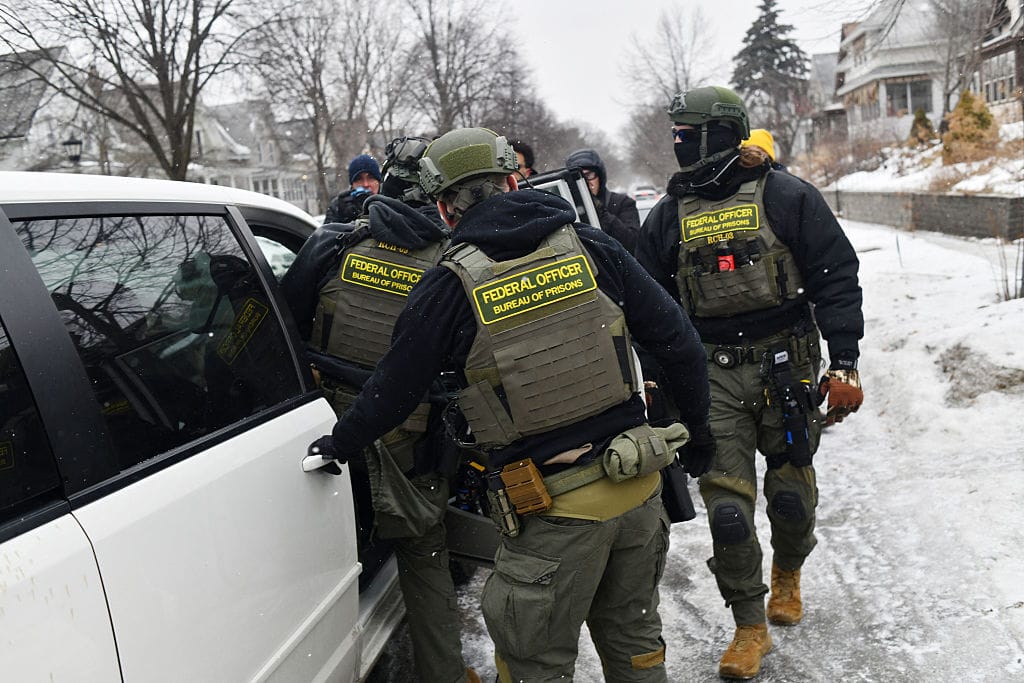
An immigration enforcement action in Minneapolis on Friday that involved, oddly, personnel from the Bureau of Prisons. (Photo by Octavio JONES / AFP via Getty Images)
Overall, federal agents (and especially prison guards) aren’t meant to be street cops.
The Border Patrol and ICE are just not trained, prepared, or accustomed to patrolling “regular” America and rolling through neighborhoods, school grounds, parking lots. They’re not regular police, and they don’t know how to behave in this moment. They don’t have the muscle memory or de-escalation skills of dealing with angry citizens or innocent people. It’s clear that many of them lack real-world policing skills. They deploy tear gas or pepper spray as a first line of defense, rather than as a last resort, which is how you’d normally police agencies use it.
In most police agencies, using pepper spray counts as a use-of-force and comes with paperwork and supervisory review. ICE and CBP are using chemical agents almost recreationally and prophylactically, in moments where there’s no physical harm or risk to them — moments where their violence is the only violence at the scene. There’s a reason that in city after city, federal judges have to issue court order limiting their use of pepper spray and chemical agents and telling them to respect peaceful protesters.
In fact, I’m struck watching video after video about how bad the street tactics of ICE officers and CBP agents are — gangs of agents surround people or vehicles (like with Renee Good) shouting competing and contradictory commands. How, at a moment of great stress, is anyone supposed to know who to follow? There’s no teamwork or practiced movements; there’s no one in command directing a fine ballet of policework. They resort to force faster than trained police would, use deadly force more recklessly in situations where it’s not warranted, and — as with Renee Good — too often turn to firearms when they get “frustrated” and not because there’s any risk. Everything they do is like some combination of pee-wee wrestling and pee-wee “run to the ball” soccer game.
What you’re seeing on the streets right now is that ICE and CBP are literally scared to be out in public. ICE is completely outmatched on the streets. (Trump and Stephen Miller, meanwhile, have so soured on ICE’s leadership that they actually moved to install more aggressive Border Patrol leadership, more aligned with Bovino, into ICE.) Both agencies are in over their heads, beyond their skill sets, and they’re resorting to brutality and violence because (a) they don’t know better and (b) they’re not bound by any of the normal accountability one expects a police force to abide by in a free and open society.
For now, as an even larger cohort of even less qualified and less trained ICE officers begin to hit the streets, this is all almost certainly going to get worse.
The Sad, Underwhelming Results of the Tactics Shift:
The tactics shift from “quality” to “quantity” is reflected in the statistics we’re beginning to see come of the Trump administration, especially how most people now detained by ICE have no criminal record. A CATO roundup in November found that “nearly three in four (73 percent) had no criminal conviction” and just “5 percent had a violent criminal conviction.” This isn’t the “worst of the worst” anymore. We know precisely how much of ICE and CBP’s current strategy is just out-and-out racial profiling because during the brief window last summer when an LA judge ordered them to stop racial profiling, arrests dropped by 2/3.
The deportation rate of people without criminal convictions went up nearly ten-fold in 2025, and the rate of deportations of people who have been in the US for four years or longer nearly tripled. (It’s worth noting, too, that despite the violence, brutality, and new tactics, ICE is still far short of the “3,000-a-day” goal — overall, new reporting Sunday from the New York Times shows ICE and CBP managed about 230,000 new deportations from the interior of the country, far more than past administrations, but still only about 600-a-day through President Trump’s time in office in 2025.)
Moreover, it seems quite clear that the “surges” we’ve experienced across the country are mostly made-for-TV-and-social-media terror campaigns, not serious law enforcement operations. When Minnesota Public Radio investigated a DHS press release about the “worst of the worst” it has captured in Minneapolis, it turned out ICE and CBP were mostly taking credit for criminals who were already in Minnesota prisons and turned over to ICE as part of routine, existing operations. Of the 13 “worst of the worst” trumpeted by DHS, it appears that a maximum of just one might have been captured by CBP or ICE in the surge — some of the 13 were actually handed over to ICE by Minnesota authorities years ago in previous administrations.
Three thousand federal agents working for weeks in Minnesota, with intensive logistics required to back them up, all to capture a small handful of "worst of the worst” makes clear that none of this spectacle is about making America safer.
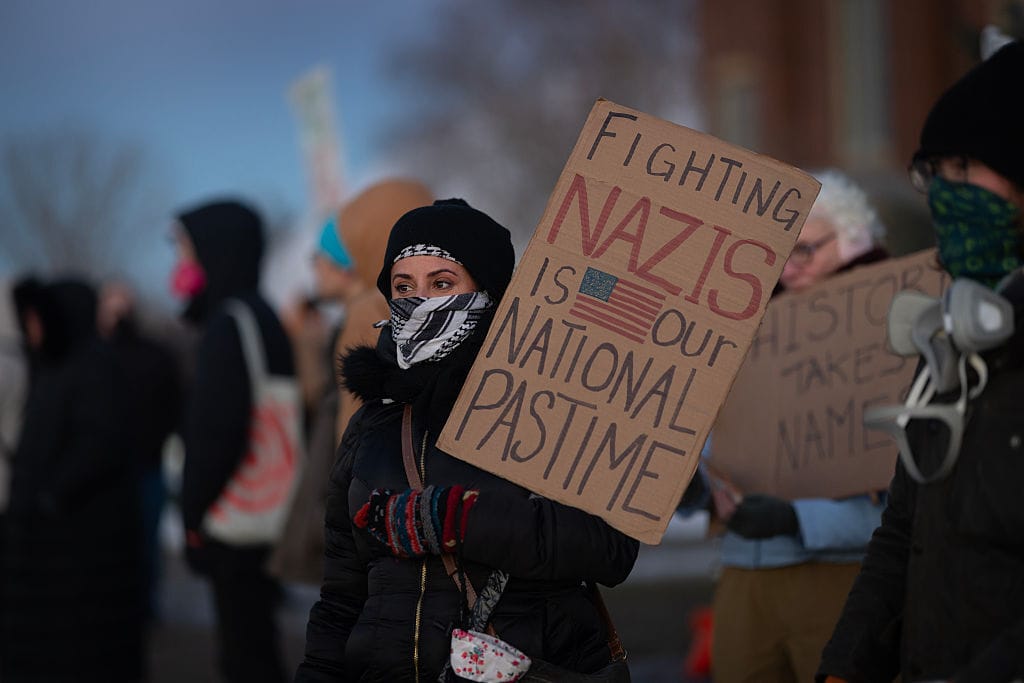
Minnesota is resisting — and winning. (Photo by Scott Olson/Getty Images)
A Reason for Hope:
Minneapolis’s strong resistance is showing the truth behind my observation last month about how Greg Bovino’s “Confederate rebel cavalry” is losing. A main part of the reason that ICE and CBP is operating so scared on the streets is because they’re being overwhelmed by the resistance. People are videotaping them, following them, warning neighbors, trying to aid the immigrants they’re attacking. Despite what might seem like their overwhelming force, those 3,000 CBP agents and ICE officers are wildly outnumbered by Angry Minnesota Neighbors. Moreover, these Bovino operations are hugely resource-intensive, and can only happen in 2-3 cities at the same time across the country.
The terror — and danger — is real, yes, but don’t let that blind you to the fact that right now on America’s streets, good people are winning.
Americans understand what’s at stake — and as with the photo above, and this haunting ready-to-print-at-home poster from a South Philly artist, America doesn’t like fascists.
GMG
PS: If you’ve found this useful, I hope you’ll consider subscribing and sharing this newsletter with a few friends: