- Doomsday Scenario
- Posts
- Donald Trump is losing.
Donald Trump is losing.
Seven conclusions as 2025 winds down.

Garrett Graff
December 12, 2025 • Reading Time: 9 minutes
Welcome to Doomsday Scenario, my regular column on national security, geopolitics, history, and—unfortunately—the fight for democracy in the Trump era. I hope if you’re coming to this online, you’ll consider subscribing right here. It’s easy—and free:
Three items to start this morning:
If you’re in or around New York City, please join me Tuesday night at the Roosevelt House for my final book talk of the year, where I’ll be speaking with Harold Holzer about THE DEVIL REACHED TOWARD THE SKY. You can RSVP here or watch online, Tuesday night at 6 pm ET.
It’s not too late to order an inscribed copy of the book for your favorite history nerd (or yourself!) for the holidays — or take a look at my full run-down of the best books I read this year if you’re still on the hunt for gift inspiration for yourself or others.
Pending breaking news and perhaps one most look-back next week, this will likely be my last column of the year. Thanks to all of you who have read along. beehiiv tells me that this newsletter received some 2.2 million “impressions” over the course of the year, which for a random side project is pretty wonderful. I’ve enjoyed the feedback from you readers and meeting some of you at events in-person throughout the year. I appreciate that you have chosen to make me part of your information diet — attention is a scarce commodity in modern times, and I hope that you’ve found this valuable. (And, by the way, some exciting news to come about how this newsletter will grow next year!)
Onto the news:
As my final column of the year, I wanted to take some stock of where our country stands as 2025 winds down. The events of this week drive an inescapable conclusion: Donald Trump is losing.
In the first months of the year, Trump seemed to be on quite the march. It seemed many days like the United States was careening toward fascism — and, indeed, I still believe that sometime in August we crossed a never-before-crossed invisible line into an authoritarian state — but since the summer, Trump’s efforts to cement his corrupt rule have faltered. Whether traditional American democracy and rule-of-law will return in the future remains very much an open question, but I’m more hopeful in recent weeks than I have been all year.
To understand what we’ve learned about Trumpism and the sources of resilience for American democracy, I wanted to lay out seven conclusions from this fall:
1) Donald Trump is losing; he is weak and getting weaker. Yesterday — Thursday — was one of the worst days of Donald Trump’s second term yet, one where Trumpism lost time and again at the state level, in courtrooms, and in the halls of Congress. Never this year has Donald Trump looked as weak as he did yesterday.
First, after launching a massive mid-year nationwide redistricting effort that could have locked in GOP minority rule in Congress for years to come, the GOP effort looks at best a wash ahead of the 2026 midterms — minor progress that has come at enormous political cost and rancor and that has fired up opposition across the country.
Yesterday, solidly red Indiana became the latest state to stop the effort in its tracks. The Indiana rebuke was remarkable: Trump’s team rolled out the most severe of threats, with the Heritage Foundation writing on X, “President Trump has made it clear to Indiana leaders: if the Indiana Senate fails to pass the map, all federal funding will be stripped from the state. Roads will not be paved. Guard bases will close. Major projects will stop. These are the stakes and every NO vote will be to blame.” (Officially, the White House denied making such threats.) And yet in the end even a majority of the GOP senators in the legislature voted to oppose the redistricting effort.
Yesterday added more proof in two key areas that the rule-of-law continues to assert itself, despite the Trump administration’s attempts to weaponize the justice system and courts against its designated enemies. First, a second grand jury rejected indicting New York Attorney General Letitia James; the initial attempt by Lindsay Halligan was thrown out. A second attempt to indict her failed last week in Virginia — and now a third one has too.
Second, in one of the longest-running and most fraught legal showdowns of the year, a federal judge released Kilmar Abrego Garcia and prohibited ICE from detaining him again — concluding that across months and months of legal battles, the Trump administration never proved that it had a valid final deportation order for Abrego, who was wrongfully removed to a torture gulag in El Salvador in March and then returned, finally after much fighting, to the US in the summer. “His removal cannot be considered reasonably foreseeable, imminent, or consistent with due process,” U.S. District Judge Paula Xinis wrote. She continued, “Since Abrego Garcia’s wrongful detention in El Salvador, he has been re-detained, again without lawful authority.”
Trump’s economic agenda — never well considered — is faltering and his approval ratings continue to slip as consumers become convinced he has no answers for the affordability crisis (a crisis, of course, that he’s made worse all year). The House even voted yesterday to overturn a Trump executive order. And the increasing questions about his health — and there should be more of them than there are! — make clear that the vigorous energetic bully we’ve seen dominate American politics for a decade won’t hold onto power forever.
Moreover, weakness in politics begets more weakness. Power abhors a vacuum, and there’s a big vacuum forming on the right.
Which brings me to:
2) The GOP is in retreat (for now) and the Great MAGA Fracturing is already underway. Recent weeks have seen increasing signs, too, that Donald Trump is a lame duck and that the fight for the future of MAGA is beginning. The confederation of conspiracists who underpin the right-wing media ecosystem are fighting. Democrats continue to win in places they usually don’t — this week added the mayor of Miami to that column, which was won by a Democrat for the first time in nearly 30 years. And the GOP is fracturing and fighting on Capitol Hill like we haven’t seen since the 2023 fight for speaker in the House. Mike Johnson has never been a strong speaker, but he looks increasingly weak and small and insignificant in recent days. And speaking of shrinking small men:
3) Greg Bovino and the administration’s brown-shirt immigration crackdown, which once loomed so large, looks smaller month by month. I’ve written often this summer and fall about the threat of CBP commander’s Greg Bovino “Confederate cavalry,” and it’s remarkable to me how in each city he now hits, the “scare factor” is less than before. New Orleans is the latest city to organize quickly and effectively to counter and reject his raiders. This is not to downplay the very real harm he and ICE operations more broadly are doing to communities around the country — as just one example, there’s growing evidence that CBP operations negatively impact school attendance — but it’s an acknowledgement that America is resisting and it’s working.
Next year will be hard — the turbocharging of ICE and CBP’s budget will only really kick in over the months ahead — but there’s plenty of reason to believe that ICE is going to struggle to accomplish its most ambitious goals. And it seems increasingly likely that immigration will be a negative for Trump and the GOP politically in 2026; Americans don’t like what they’re seeing happening to their neighbors.
Which leads me to:
4) Individuals have been strong, where institutions have been weak. I have always believed that one of America’s greatest strengths is its institutions; they are meant to be the keepers, generation to generation, of long-term values and norms in public life — the pillars of our communities, both local and national. Many of us spend much of our professional lives investing in these organizations — giant long-lasting companies, nonprofits or NGOs, or colleges and universities. Never have we seen so many of them fail the most basic of tests. Law firms, universities, and media companies have kow-towed to Trump one after another — often inexplicably, at great reputational cost, while getting almost nothing meaningful in return.
Plenty of American CEOs have proven themselves to be quite morally flexible; plenty of them appear willing to pay once-unthinkable bribes if it helps their business, even unconstitutional export taxes! Automotive executives stood silently behind Trump last week as he continued to say reprehensible things about Somali-Americans and a major American city. Jeff Bezos showed up to a gala dinner honoring the man who ordered the killing of one of Bezos’ own employees.
That fundamental cowardice and weakness stands in sharp contrast to the many Americans who have bravely stood up at an individual level — from the “Portland frog” to the many who have shouted down ICE and CBP officers in their local neighborhoods, sometimes at great personal risk.
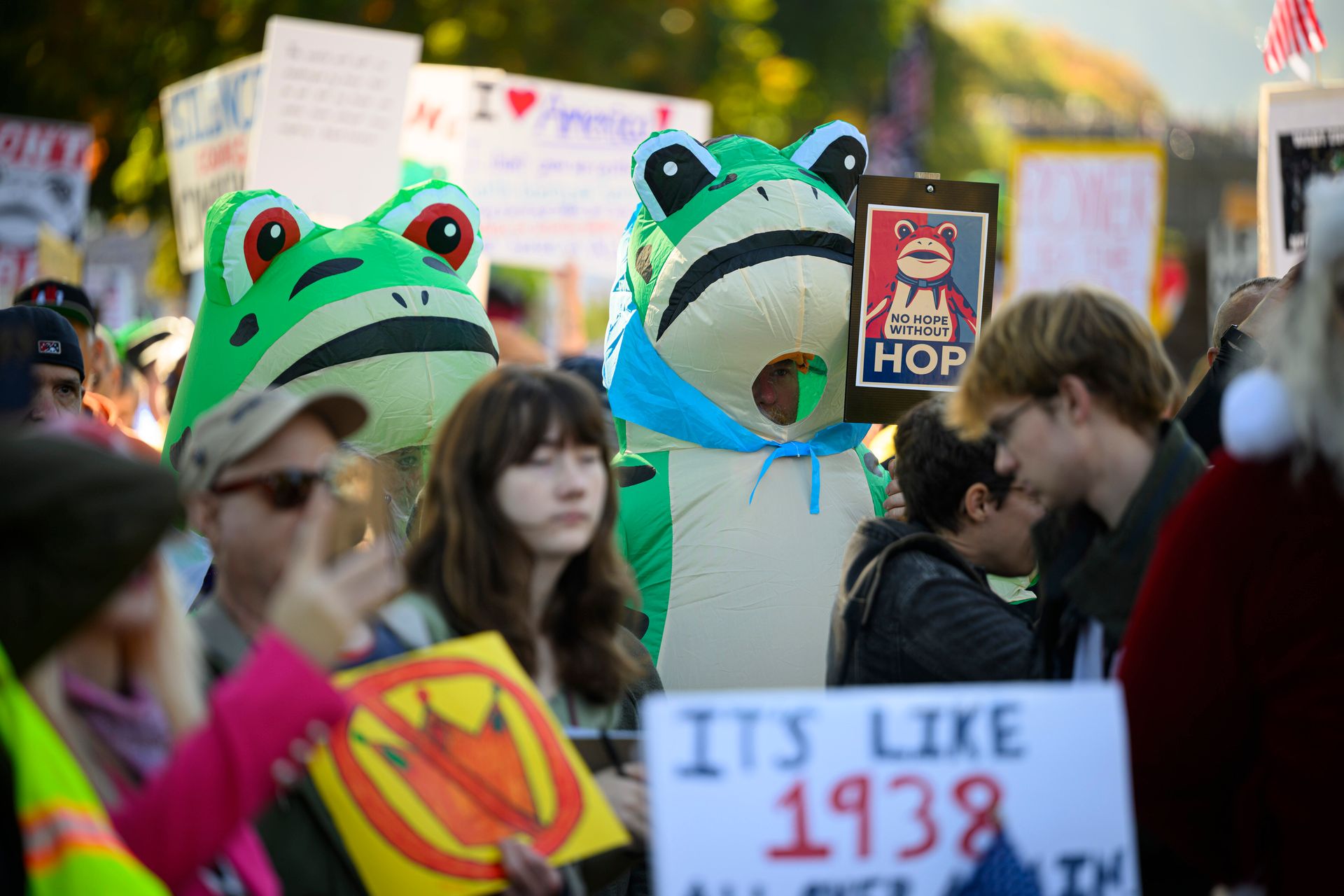
America’s frogs have fought harder for democracy than the Democratic leadership on Capitol Hill. (Photo by Mathieu Lewis-Rolland/Getty Images)
This all stands especially true of the Democratic Party leadership: It’s impossible not to notice how many rank-and-file and up-and-coming Democrats, from the Newark mayor to Illinois congressional candidate Kat Abughazaleh, who was beaten by ICE officers, to New York comptroller Brad Lander, have put their bodies on the line, even as Chuck Schumer and Hakeem Jeffries continue to pretend that they’re operating in some normal situation on Capitol Hill. Even as late as this week, Hakeem Jeffries can’t be bothered to support an impeachment resolution condemning Donald Trump for calling for the execution of Democratic Members of Congress.
That we can’t even unite Democrats around the idea that the president should not publicly call for the execution of members of the legislative branch helps indicate:
5) Even if Trumpism fails, America is fundamentally changed. We have always told ourselves “it can’t happen here.” But it now has — and we can never look at our country the same again. Trump has made American daily life coarser, more rude, and less welcoming to others. We have seen fundamental tears this year in the civic fabric of our country and communities. We now recognize and confront strains of our neighbors — especially racism and misogyny — in a way more naked and violent than most of us had believed possible in the 21st century. Decades of progress in welcoming trans people and people with disabilities and different learning styles into American life have been unwound; decades of hard-fought progress by Blacks and women in the military and government have been undone. (Marco Rubio this week changed the “woke” font the State Department switched to in recent years because Calibri is easier to read than Times New Roman if you have certain learning disabilities. How petty can you be?)
No foreign entrepreneur or high-skilled immigrant student will look at the US with the sense of safety, security, and opportunity that they did before January 20th. Once-secure research positions at labs, universities, and medical centers will never feel as sure-a-thing as they did.
We still haven’t recognized how much of the basic fabric of the US Trump has altered — from the sense that media organizations need to bend toward Trump to avoid business problems to the idea that immigrants don’t have a fundamental right to free speech here. A nakedly partisan and extremist Supreme Court continues to enable and supercharge a presidency that doesn’t need any more power, and we’re likely to see bedrocks like civil rights legislation unwound in the months ahead. Which leads me to:
6) The world will never look at the United States the same again. We have shattered the halo that has existed around the United States for much of the world across the eight decades since World War II — and, in many cases, even longer. By closing our doors to the world’s brightest and most ambitious immigrants, by becoming the most unreliable of world partner, by embracing corruption in government like a second-tier banana republic, and by committing literal war crimes and murder on the high seas, the US is showing a different side of itself to the world. The disappearance of USAID will mean millions of deaths in years to come; the “values gulf” between us and adversaries like Russia and China has shrunk dramatically on the world stage. Many countries are weighing their alliances not between “authoritarianism” vs. “democracy” anymore; instead: Would you prefer a corrupt American administration or a corrupt Chinese one? Trump has made clear that one-time pariahs like Saudi Arabia’s MBS are not only welcome in the United States, but he’s willing to literally stand with MBS and insult Jamal Khashoggi. Meanwhile, the US government would rather chose the side of Russia than allies like Ukraine.
The legacy of “America First” long-term is going to be a country that will never be able to reintegrate itself in the world community in the same way again.
We don’t talk enough about moments like this: When Danish intelligence — traditionally the closest of US allies, and one with immense and important capabilities — says it can’t trust the US anymore as an ally. The latest Danish intelligence threat assessment actually listed the US as a threat: “The United States uses economic power, including threats of high tariffs, to enforce its will, and no longer rules out the use of military force, even against allies.”
Which leads me to:
7) Accountability must come. As Brian Beutler wrote last month, “The attempt to speed-run authoritarianism has failed. The new acute danger is greater political violence (Trump calling for hangings, etc). But the concerted danger is down the line, when MAGA realizes the bill for all this corruption will come due.” The shortest possible answer is that Trump (or Vance or whoever oversees the final chapter of Trumpism) just issues blanket pardons to everyone from ICE officers to Cabinet secretaries. But we must not allow that to be the end of the story. America got to this point because we have systematically failed to hold elites to account, from systemic under-prosecution of white collar crimes to the 2008 financial crisis to Jeffrey Epstein to Trump after January 6th.
There can be no “let’s just turn the page” kumbaya after Trump; as I said in a speech last week, the Biden administration’s original sin was believing that January 6th was the end of something, rather than the beginning. We must ensure that once it falls, Trumpism and authoritarianism cannot rise again in America.
Whatever reform agenda someday grows out of this, we must not rely on “norms” and “tradition” as we have before; too many institutions, like the Justice Department, have turned out to be eminently corruptible if you just ignore the process. (As I wrote this fall: The only check-and-balance that matters turns out to be good character.) There must be laws and enforcement mechanisms going forward. And we must strive, most of all, to return and empower people of good character in public office.
This has been a dark year, for sure, but as we head into the holidays and — I hope — life quiets down for a bit, I enter this season with hope I haven’t felt for most of 2025. My hope for you is that you feel it as well. The fundamental promise of America has always been that its best days lie ahead — that there is no golden age of American democracy because it will always get better — and, as the year closes, I still believe in that promise.
GMG
PS: If you’ve found this useful, I hope you’ll consider subscribing and sharing this newsletter with a few friends: